
Finding the Right Verifier
 There is an old saying I heard years ago—I don’t know where it came from:
“If all you have is a hammer, everything looks like a nail.”
Having the right tool is important, and not all of them (including hammers) are the same.
This may be especially true of barcode verifiers. We have a range of brands and models in our testing lab. Although they share similarities, the capabilities and features range widely.
Hardware
Hardware variations are the most obvious. For example, we use a brand and model for most of our Direct Part Mark verification. Scanning barcodes that are laser-etched directly onto a plastic or metal substrate requires specialized illumination; therefore, verification of these barcodes must likewise support a range of illumination settings. Remember, the purpose of verification is to predict whether the barcode will decode efficiently and correctly with a scanner. Standards are what make this possible—and reliable.

Software
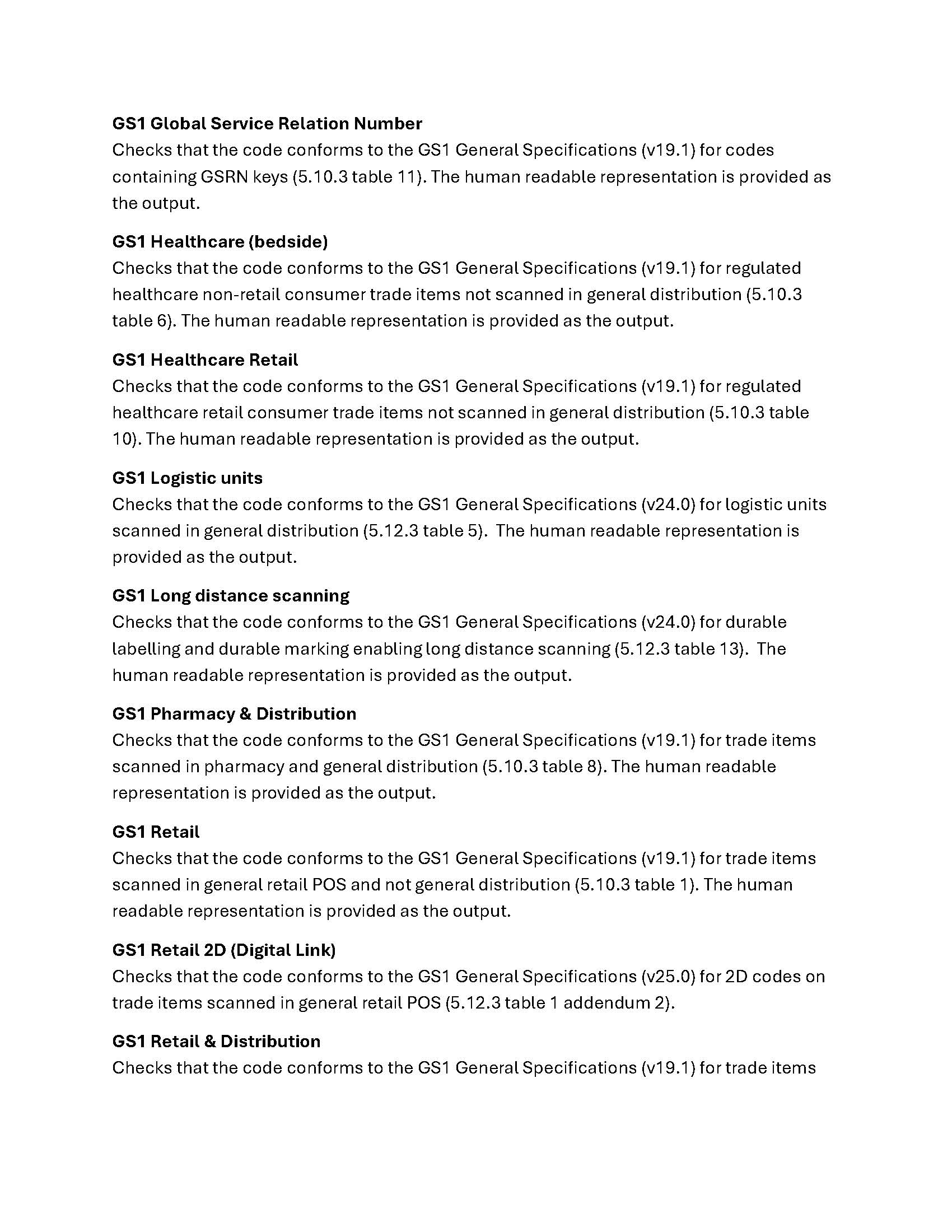
This is a small portion of the plugins for Axicon 15000 series verifiers
Verifier software variations are more subtle. Customers looking for a verifier are often unaware of the importance of the software, and supporting the ISO print quality standards is only part of that important consideration. Here are some things good verifier software can do:
- Validate that the barcode corresponds to the product: it’s great when the verifier gives a passing grade for print quality, but that good barcode is a disaster if it’s on the wrong product. Not all verifiers can do this.
- Identify and auto-discriminate different barcode types: not all verifiers automatically determine the barcode type (for example, Code 128, ITF, Code 39 or GS1 variants vs standard types).
- Full ISO verification: some verifiers cannot perform the full ISO verification. Handheld, gun-type verifiers fail the ISO requirement of fixed distance and angle to the barcode, which is necessary to accurately grade reflectance.
Verifier software plugins allow users to configure the verifier for attributes it cannot automatically detect. For example, a GS1 Healthcare Data Matrix code should have elements within a specific size range that is different for logistics than for bedside or retail usage.
Tool Configuration
Advanced verifiers offer a wide range of plugins to help users solve problems. One brand provides a plugin that lets users specify an acceptable date range for all 14 GS1 Application Identifiers. This includes Production, Expiration, Best Use By, and other important dates encoded in the compliant barcode. Without that capability, the verifier could give a barcode a passing grade for print quality, and the user would be completely unaware that the barcode fails an important attribute.
Like all technology, barcode verifiers are dynamic tools—evolving and adapting with barcode technology, new applications and regulatory requirements. If you are looking for a verifier, we can help you find the right one, whether or not we sell it.
Smart and Wise
Make a wise investment. Neither the cheapest nor the most expensive tool may be the right one. Verifiers are risk management. The right one pays for itself in the protection it provides.

Contact us here.