Like most innovations, barcode technology started with a problem looking for a solution. Unlike a lot of solutions, barcode technology wasn’t possible without the existence of a solution that had not yet found a problem it could solve. That solution was the laser.
A Problem Looking for a Solution and a Solution Looking for a Problem
 The nearest thing to a barcode as we know it was the invented by Bernard Silver and Norman Woodland; they won a patent in 1952. Instead of a picket-fence pattern of bars and spaces, the Silver-Woodland barcode was an array of concentric rings not unlike a bull’s-eye. The patent describes omni-directional scanning with an electro-mechanical device. Unfortunately the circular pattern was difficult to print accurately, and the scanning device was not feasible, so the barcode solution went nowhere.
David Collins, Barcode Pioneer
In 1959, David Collins was looking for a way to automatically identify railroad cars for his employer, the Pennsylvania Railroad. His system, called Kar Trak, was a barcode-like pattern of red and blue reflective stripes. These encoded a company and a car number on the sides of the railroad cars. Economic factors and decoding problems due to dirt on the railroad cars killed the concept, but Collins recognized a growing need for this technology in other applications.
A few years earlier, Charles Townes and Arthur Schawlow at Bell Labs developed microwave amplification by stimulated emission or radiation (Maser). But, in 1957, Gordon Gould, a graduate student at Columbia University, realized that the concept would work better with short wavelength visible light. Gould invented light amplification by stimulated emission of radiation (Laser). Stimulated emission was a process first described theoretically by Albert Einstein in 1917.

Computer Identics and General Motors 1969
Re-enter David Collins, who formed Computer Identics Corporation in 1967. He began working with lasers instead of heavy, heat-producing photo-multipliers to decode black and white barcodes. Computer Identics installed its first scanning system at a General Motors plant in Flint, Michigan in 1969, identifying transmissions on a moving conveyor line. By this time, the U.S Postal Service was investigating the use of barcodes to track vehicle movement in their facilities. Pet food manufacturer KalKan was looking for a cheaper and simpler way of controlling inventory.
These developments caught the attention of the National Association of Food Chains. They hosted a discussion about automated checkout at an association meeting in 1966. RCA bought the rights to the Woodland patent. They were present at the NAFC meeting. Association member Kroger volunteered to test the concept at a store in Cincinnati. By the mid-1970’s NAFC had formed the U.S. Supermarket Ad Hoc Committee, studying feasibility of a Uniform Grocery Product Code; the committee’s mission: establish guidelines for formation of barcoding standards.
National Association of Food Chains and Kroger
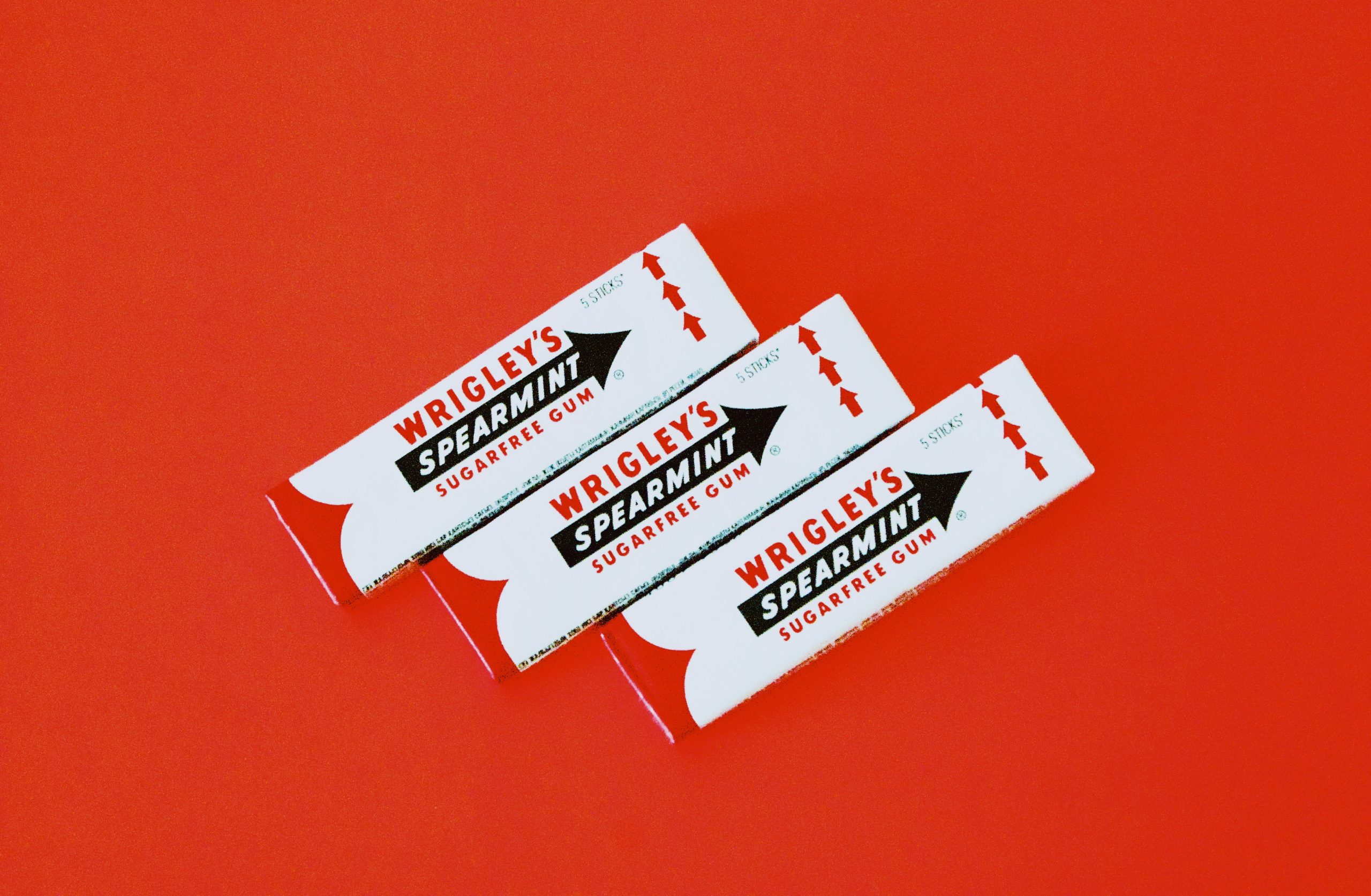
The 18 month test revealed problems with the bulls-eye configuration which was vulnerable to smearing and linear distortion. Picket-fence style linear barcodes solved this problem. The first commercially scanned barcode took place On June 26, 1974. It was a 10 pack of Wrigley Juicy Fruit gum, in Marsh’s Supermarket, Troy, Ohio. Fotel, Inc. in Villa park, Illinois manufactured the film master for that barcode. I worked on that project as a summer intern.