
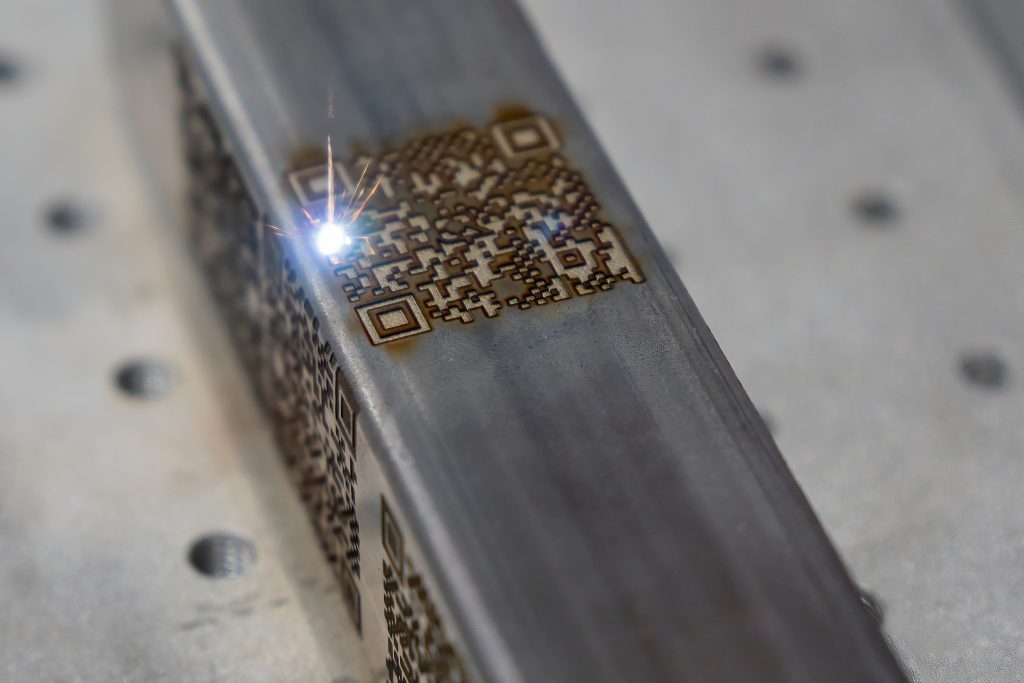
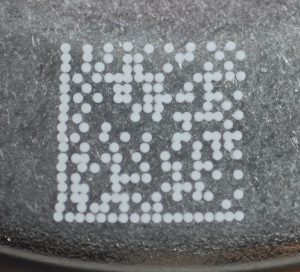
 Until recently, I believed DPM was a straightforward, singular technology. Laser etching or ablating a barcode directly onto a metal or plastic machine part or subassembly was DPM, pure and simple. Printing a barcode on a label or package was not DPM. I thought of DPM as a process. Here is how the ISO organization defines DPM .
The ISO/IEC 29158 definition of DPM is as follows:
“Direct Part Marking (DPM) is a technology whereby, generally, an item is physically altered to produce two different surface conditions.”
Hmm…
Hmm, not sure this reassures me of my correctness.
Recently, barcodes are laser-imaged on logistics packaging by ablating the image from a patch of black coating. No problem with negative imaging–Datamatrix barcodes readily accept negative imaging. but is this DPM? It is a package, not a part or subassembly.
More Hmm…
Upon more careful reading of the ISO/IEC 29158 definition, ablating in this manner fits the description. So then, what is DPM?
One consideration is that DPM is based on a low reflective difference between the barcode and the substrate. Barcodes printed on labels have a required and relatively high minimum difference in reflectivity between the barcode and the background.
Another consideration is illumination. A DPM scanner has a range of lighting angles to enhance the reflective differences, enabling the scanner to capture and decode the barcode. It’s easy to see how this might make a directedly imaged barcode on a metal part easier to scan: the barcode reflects light differently than the rest of the substrate.

Doesn’t that disqualify a barcode laser-ablated out of a black patch on a cardboard box? Not necessarily. Conventional scanners for printed barcodes operate at 45 degrees. DPM scanners also have a 45-degree setting (and several other angles too).
By now, maybe you are wondering if this is not just a tempest in a teapot. What’s the big deal? Well…
There another difference between a conventional scanner and a DPM scanner.
This is the less obvious difference between a conventional scanner and a DPM scanner. The latter can optimize the maximum and minimum reflectance levels to make the subtle transitions between dark and light more evident.
That is the key to defining and, therefore, differentiating DPM. Although there may be process differences in how the image is created, what is—and what is not—DPM comes down to scanning. If special illumination and reflectance enhancement are required, it’s DPM.
Risk Management or Wishful Thinking
Sidenote: barcode verification is a standards-based method to predict that a barcode will scan properly out there in the real world, with a variety of scanners in various environments. Since bad barcodes can be a significant liability, verification is an important form of risk management. Tweaking the verifier to get a better verification grade defeats this. Using DPM settings to get a better verification grade on a barcode printed on a label is a bad idea. Yes, we have seen this done.
 Questions? Contact us here.


