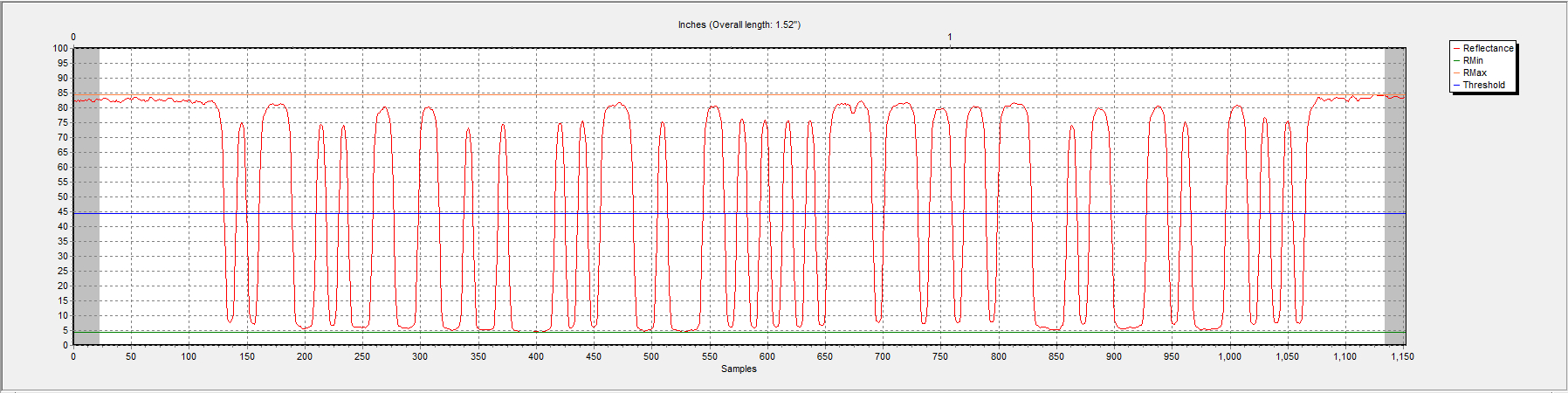
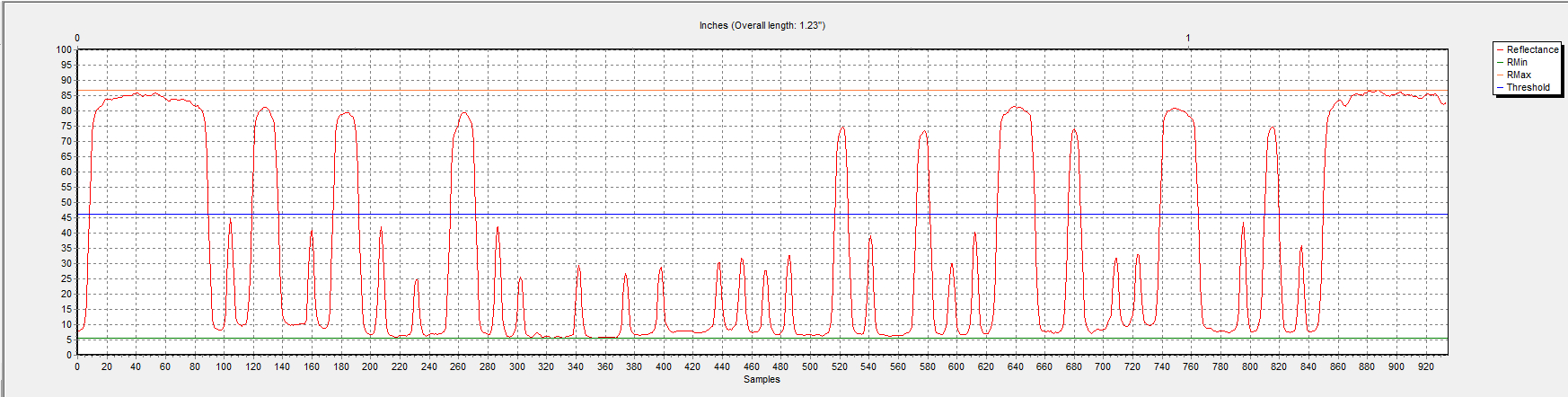
The Scan Reflectance Profile (SRP) is a primary tool for diagnosing barcode problems. It graphically represents the entire barcode and its scanning performance. This is the most important tool for understanding problems with your barcode and how to fix them.
Other than an incorrect check digit, all barcode scanning problems can be diagnosed with the SRP. But first a deeper look at how a scanner works.

General Barcode Troubleshooting and Basic Terms
Scanners use software to find the barcode and determine the specific type of barcode by detecting the fixed patterns that uniquely identify it. For example:
- UPC uniquely begins and ends with a two bar/two space pattern of equal widths
- A version A UPC will always have 60 detectable reflectivity transitions from light to dark
Quiet zones provide clear space to make it easier for the scanner to detect the barcode. Encroaching graphics or text will add additional reflectivity transitions that confuse the scanner’s ability to determine symbology. A violated quiet zone on a UPC may cause 62 or more light-to-dark transitions, negating the possibility that it is a UPC—or any other known symbol type. The symbol will fail to scan.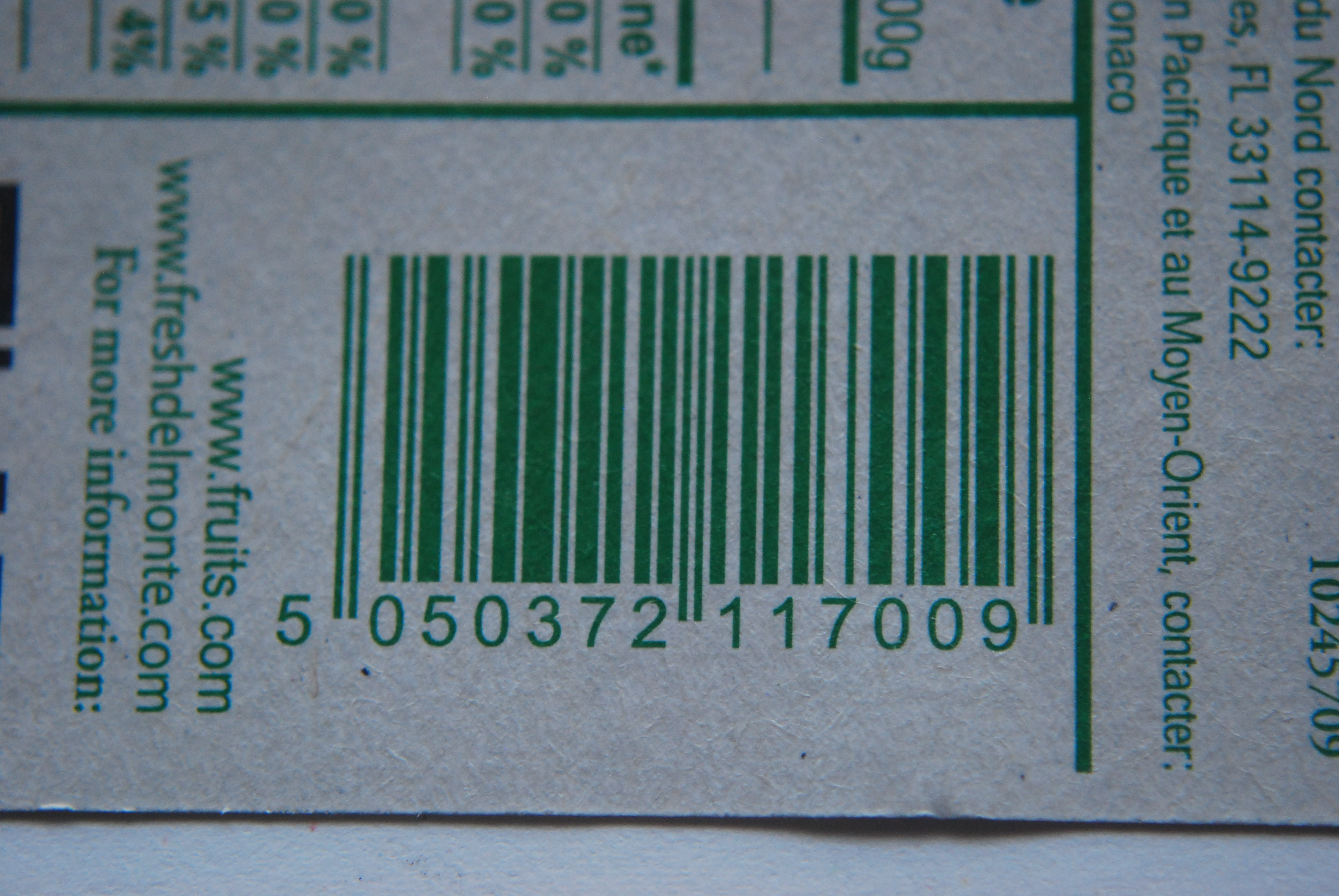
Quiet zones also provide a space for the scanner to calibrate itself to the Rmax value. If it is not uniform, the count could be thrown off and the symbol will fail to scan.
Likewise, if the Rmin values are not uniform, or if there are artifacts in the spaces or voids in the bars, the count can be inaccurate and scanning will fail.
Decoding occurs at the Global Threshold. This is the mathematical equator—the half way point between the highest Rmax value and the lowest Rmin value. It is the horizontal line drawn through the width of the barcode at the value:
(Rmin + Rmax)/2
This is the average of Rmin and Rmax.
Other things that can Create Problems with Scanning
 Excessive gain can cause the bars to spread so much that the spaces begin to disappear. This happens first with the narrow spaces, and when it occurs, the count is thrown off, the scanner can no longer identify the symbology and scanning fails.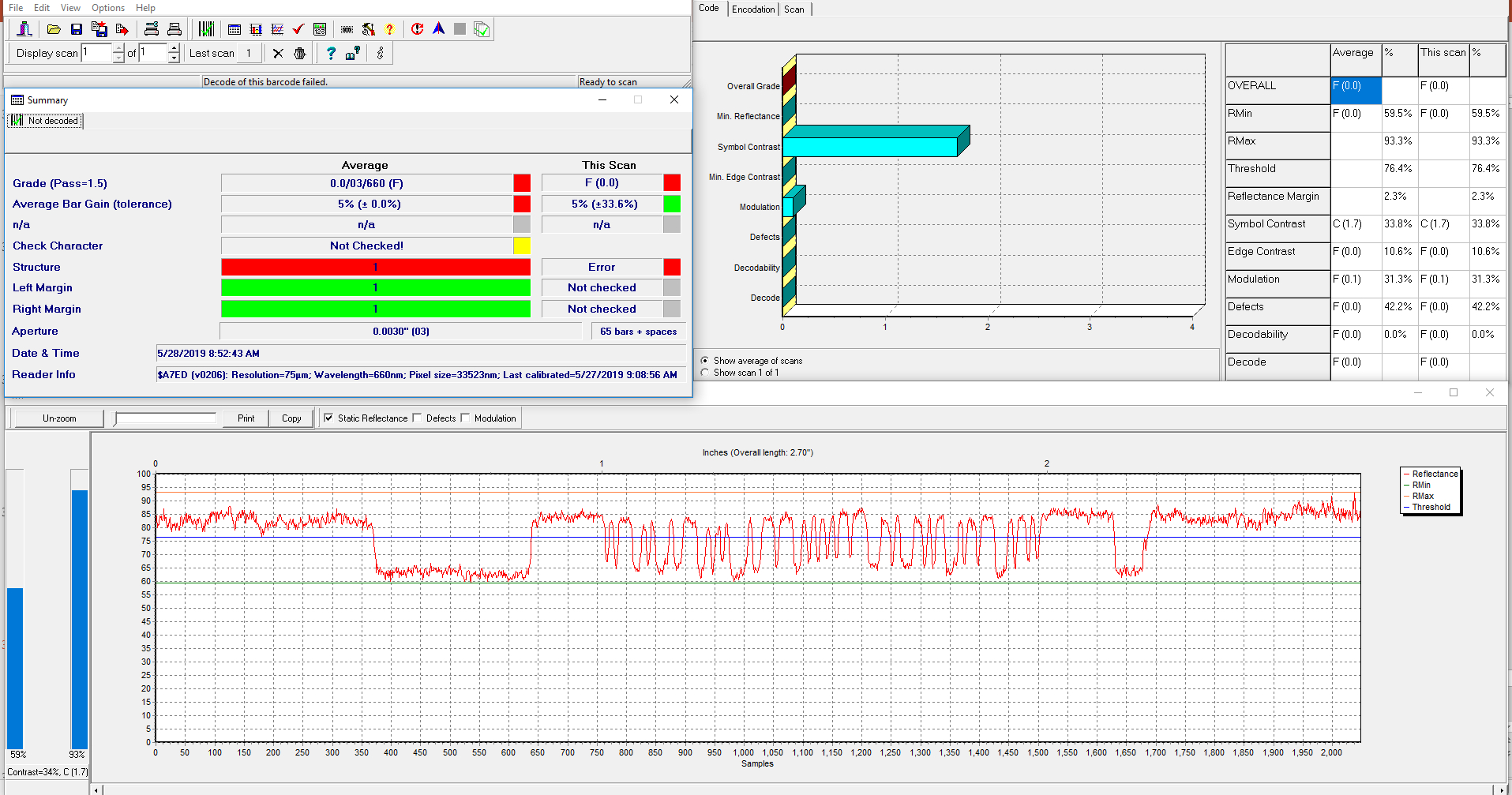
A similar problem happens with the barcode is printed in an incompatible color, such as a color in the red spectrum, or when the background is in the green spectrum.
The desired appearance of a SRP is a sine wave with a very large spread and a high degree of symmetry.
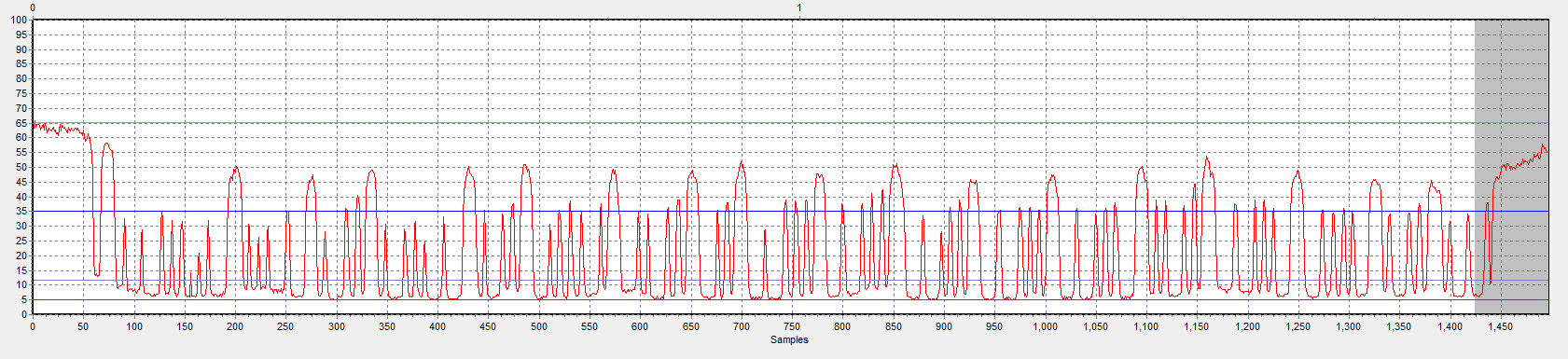 Notice what a violated quiet zone looks like on the SRP.
A verifier has the unique ability to synthesize the location of the global threshold. They can do this in order to be able to diagnose barcode problems.
Scanners cannot do this and this is one reason why using a scanner to verify a barcode is a bad idea.
- A scanner or smartphone is a go/no-go gauge. The barcode either scans or it doesn’t
- A scanner cannot alert you to problems that could cause the barcode to fail
- Your scanner (or smartphone) performs differently than somebody else’s scanner (like maybe your customer’s scanner).
Questions or comments? Contact us here.