
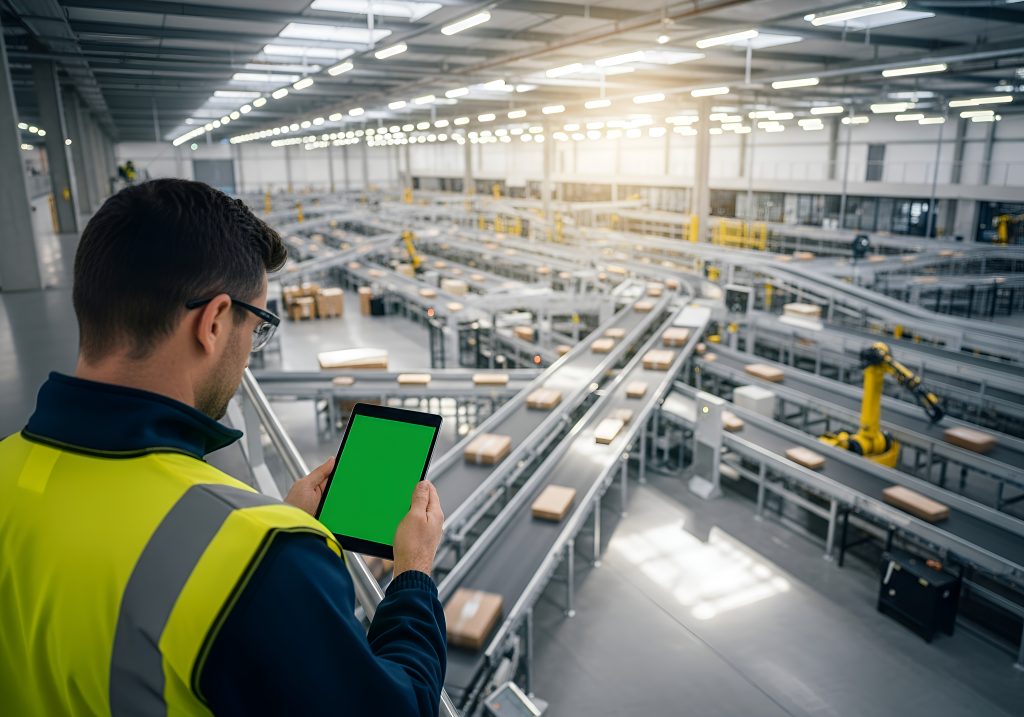
 The visibility of barcodes in retail establishments could lead one to believe that this is only where barcodes live and do their most important work. And a polite nod to barcodes in the supply chains that feed retail. Well, hang onto your hat. Behind all of the visible things barcodes do, there’s a nearly invisible layer of activity where barcodes do arguably their most important work, in warehouses.
In a modern warehouse, barcodes are nothing less than the lifeblood. Without a barcode marking each item, you don’t know what it is, where it is, or what to do with it next. Nothing moves without scanning a barcode.
The barcode is the eyes
Barcodes mark everything coming into the warehouse—what it is, how many of them arrived, and from whom. That’s just the beginning. Things don’t just get stored in

a warehouse. They move around. A lot. Often, there is a storage location, but that’s a temporary holding place. Variable items on the pallet may go to separate locations. Eventually, items go to a pick station, then on a conveyor to packaging. Every movement is scanned. Real-time scanning at every step is mission-critical. Without that, the warehouse is blind. Barcodes make it possible to track every movement in the warehouse. The barcode is the eyes of the warehouse. If the barcode doesn’t work, the item is invisible. It doesn’t exist.
Barcodes do more than just locate an item or track its movement. Barcodes can also direct automated equipment. Think of a cross-dock operation with incoming items on a central conveyor. Barcode scanners trigger diverters, shunting certain items onto branching conveyors to different locations: maybe a storage area, maybe a packing station, maybe a truck dock dedicated to a specific route. A barcode misread is worse than a data error—it’s a misroute.

Optimizing Throughput
 Warehouse orchestration elevates warehouse automation to the next level. Orchestration is just what it sounds like—intelligent on-the-fly choreography of robots, conveyors, inventory and people. Orchestration means continuous, second-by-second decision-making: which robot picks what item and sent to what destination. Sending a human all over a million-plus square foot warehouse to fulfill one order is incredibly inefficient, not to mention exhausting. Orchestration makes intelligent, respectful integration of human labor possible. Orchestration decisions are a micro supply chain. But only if the barcodes work right. A bad scan triggers a downstream catastrophe of misroutes, shipment errors and inventory discrepancies that robots and scanners cannot reconcile.
Barcodes are the lifeblood of warehouse automation and orchestration. Just like blood, barcodes travel through the system, informing it, responding to it and keeping it alive.
 Contact us here.


