
It can be difficult and confusing to relate the ISO parameters on the verification report to what is actually happening in a barcode. Here we will attempt to connect those dots in a way that makes them clearer.
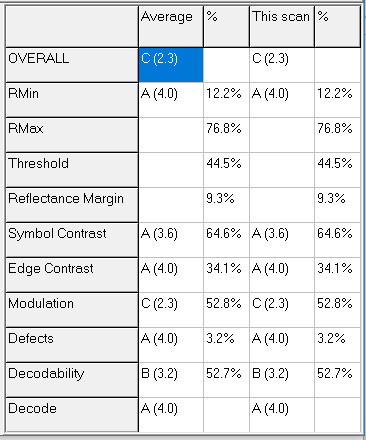 Let’s begin with the parameter Modulation. Here is how it is reported for a 1D barcode. It is downgraded to C—but why?
The verification report offers some clues. In the details window on the right, you can see that Average Bar Gain is a significant 11%,fully one-third of the bar gain tolerance of +33%, but it is not sufficiently high to earn a warning such as that shown for the X dimension on this UDI compliant Code 128.
What could be causing the Modulation issue? A close examination will reveal the issue. Click here to see a video close-up of this barcode. Knowing that Modulation detects reflectance variations in the dark and/or light reflectance values, you can easily see the unevenness of the bar color.
This graphically demonstrates the helpfulness of taking a close look at a barcode to understand the verification report.

Here is a more extreme example, a GTIN12 failing the parameter Decodability.
In this case Modulation is not involved, but Average Bar Gain is a factor–a factor of 3! 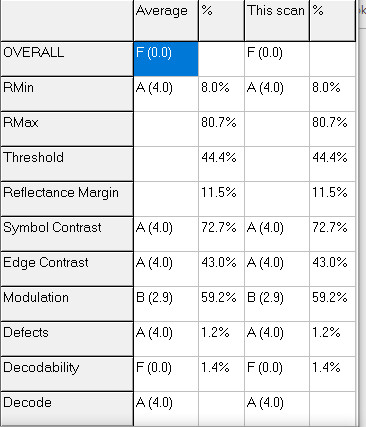
 Gain exceeds tolerance by almost 3 times. take a closer look here. The ragged edges are not nearly as problematic as are the heavily gained bars, robbing width and reflectivity from the adjacent spaces.
Verifiers are accurate and thorough, but the results can sometimes be hard to understand. A low power magnifier can help provide that understanding.
 The burned out thermal print head pixels are obvious in this macrophoto, but to the unaided eye what should be a single wide bar can appear to be two narrow bars.
Do not overlook a quick, close visual inspection of a problematic barcode. Once you know what is wrong, you can take informed steps to solving the problem.


