
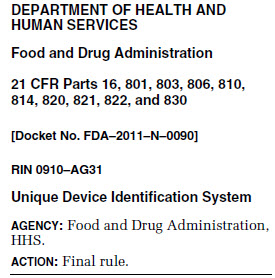
 The FDA Rule for Unique Device Identifiers on medical devices may be old news, but can be a steep slope for new medical device companies and their label or package providers. Here are some key points in sorting it out.
UDI is a Two-part Barcode
The Unique Device Identifier or UDI is a barcode, most often containing two data sets. The primary data set is the Device Identifier (DI); the secondary set is a Production Identifier (PI). The DI identifies the device. Think if it as a member of a family. The PI further identifies a more specific sub-group in that family: lot or batch, serial number, date of manufacture or expiration date.
The UDI must appear on every level of packaging of that product or device, from individuals to inner and master cartons. The logistics unit, such as the pallet, does not require UDI marking.
1D and 2D Barcodes
Barcode type is not specified, although the FDA rule does require devices to be barcoded. Several barcode symbologies are acceptable. Linear barcodes such as UPC, Code 39 and Code 128 are commonly used. 2D symbols include Data Matrix and QR Code. Which barcode type to use is a decision based on your trading partners and the supply chain.
When marking a medical device with a barcode, the FDA rule requires that the barcode and the Human Readable Interpretation (HRI) be present. The HRI is the text of letters and numbers encoded in the barcode. The rule also specifies the readable data format.

Medical Device Kits
Medical devices in kit form must also be UDI marked, but the components within the kit do not need to be individually marked, unless they are pharmaceuticals, also sold separately.
Misinterpretation of the FDA rule leads to some common mistakes. One example is in formatting the HRI. The FDA rule requires offsetting the DI and PI prefixes in parentheses. A typical UDI barcode will look like this:

Common UDI Mistakes
The common mistake is to encode the parentheses in the barcode.
Barcodes are “data carriers.” Linear barcodes can get very long when numerous DI’s are used. Sometimes they exceed the scan width of the scanner. It is tempting to convert to a 2D symbology such as Data Matrix, which has a higher data capacity and a smaller footprint. This decision must be made in concert with trading partners.
Another common UDI mistake is to incorrectly format date codes, such as date of manufacture or expiration date. The FDA rule specifies a data format of YYYYMMDD for the HRI, but the encoded data format must be YYMMDD. Confusing!
Verify!
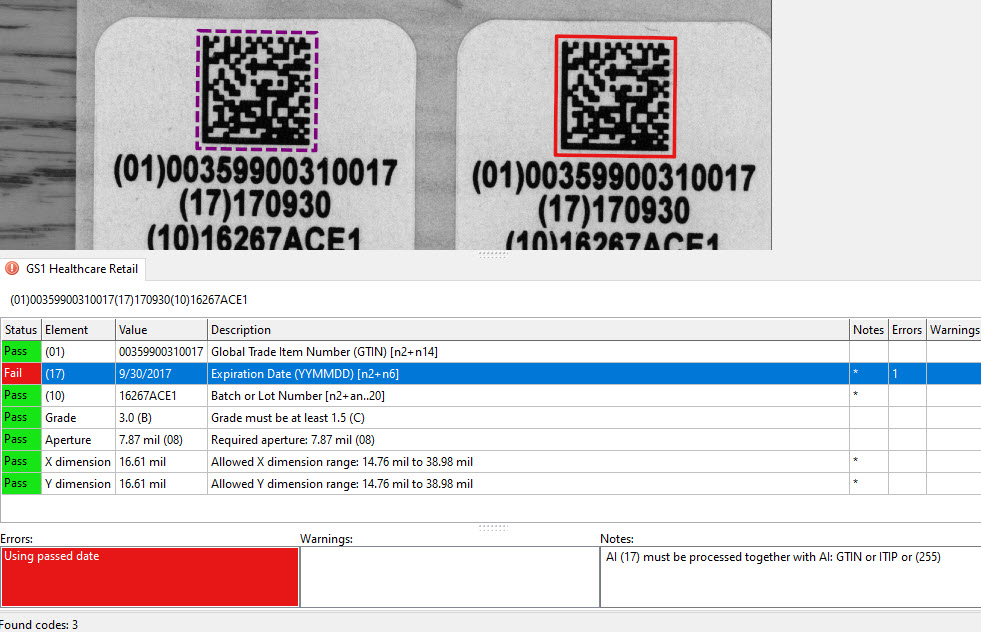 Barcode verification is the best way to ensure that your UDI barcodes are compliant, both with ISO print quality standards and UDI (or HIBCC) data format specifications. Some medical device and pharmaceutical manufacturers purchase barcode verifiers. Others prefer to use an independent barcode testing service.

Your comments and questions are always welcome. Contact us here.


