I’m having a conversation with myself, as I often do…
Q: “Hey self, what do you mean by ‘better’?”
A: “Glad you asked–you already know 2D barcodes are better at encoding more data than a linear barcode can. By ‘better’, I mean are they more forgiving and less likely to fail than linear barcodes?”
Q: “Many people believe they are, but here is the reality…”
The core difference: more data packed into less forgiving physical space.
A linear (1D) barcode — like a standard UPC — encodes data in only one dimension: the widths of vertical bars and spaces, read left to right. There’s redundancy built into the pattern, the module (bar width) tends to be relatively large, and a scanner just needs to sweep a beam across it once.
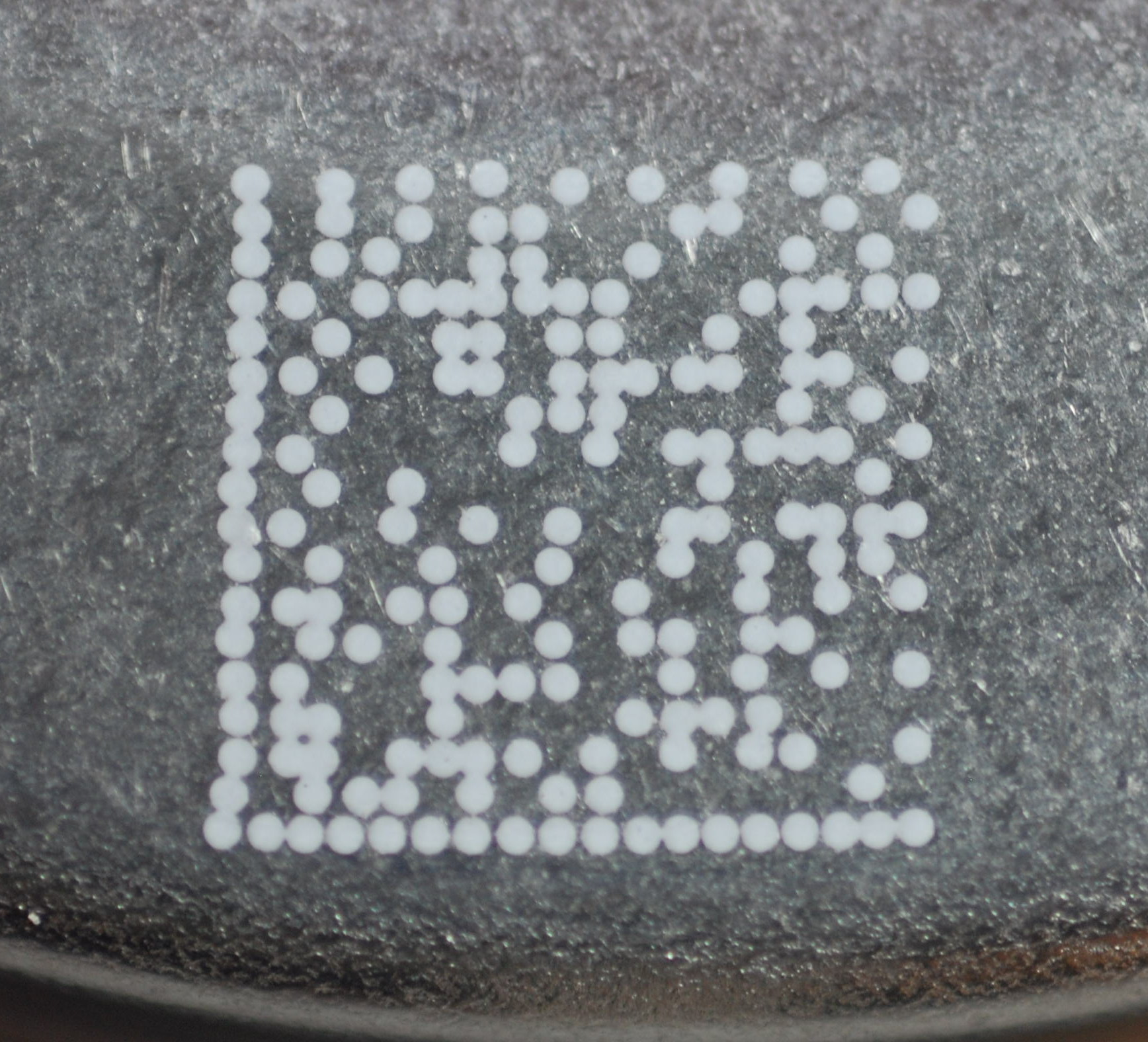
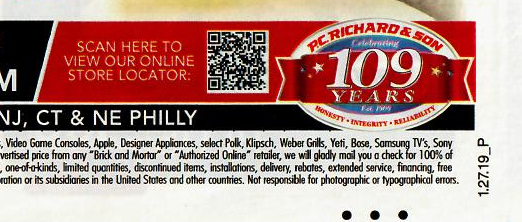
 A 2D barcode — like a GS1 DataMatrix or QR code — encodes data in a grid of small squares (modules) across both dimensions. That’s what lets it pack dramatically more data (URL, lot number, expiration date, serial number, etc.) into a much smaller physical footprint. But that density comes at a cost in tolerance:
1. Individual modules are tiny, so defects matter more. In a small DataMatrix symbol, a single module might be a fraction of a millimeter. A print defect that would barely register on a fat linear bar can wipe out an entire module — and that module might be carrying meaningful data, not just contributing to a wide bar’s overall width.
2. There’s more to grade. ISO/IEC 15415 (the 2D verification standard) checks everything 15416 does conceptually, plus parameters that don’t exist for linear codes at all:
- Fixed pattern damage — the “L”-shaped solid border and the alternating clock pattern that tell a scanner where the grid starts, how big each cell is, and how it’s oriented. Damage here doesn’t just lower a score; it can make the whole symbol unreadable, because the scanner can’t even find the grid.
- Grid nonuniformity and axial nonuniformity — whether the cells are consistently spaced and squared up, since decoding depends on the scanner correctly guessing where each cell
 boundary falls.
 - Unused error correction — 2D codes carry built-in error correction (Reed-Solomon, typically), meaning they can still decode even with some damage. A verifier checks how much of that error-correction budget got consumed reading the symbol. A code that scans perfectly today but has already used up 60% of its error correction budget is running on borrowed margin — the next bit of wear, smudging, or fading could push it over the edge into unreadable.
3. It has to be readable from any angle. Linear codes are typically read in a specific orientation (a laser sweeping across the bars). 2D codes are read omnidirectionally by imaging-bas

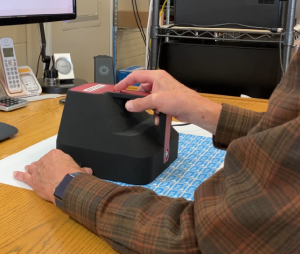
ed scanners, so the whole symbol — all four sides, all four corners — needs consistent print quality, not just a clean horizontal sweep. Some verifiers require the linear verifier to be oriented within a few degrees of North-South or East-West.
4. The quiet zone requirement is stricter and applies on all sides. A linear code only needs clear space to the left and right. A 2D code needs a clean margin on every side, and because the modules are smaller to begin with, encroachment into that margin is easier to cause by accident (tight label layouts, adjacent text, packaging folds).
The practical upshot: a 2D code can “scan fine” on a phone in good lighting while already running low on error-correction margin and only marginally passing on grid uniformity — exactly the kind of hidden weakness that a pass/fail scan check can’t detect but a graded ISO/IEC 15415 verification will catch. That’s a big part of why the Sunrise 2027 transition isn’t just “swap the barcode format” — it’s a real shift in what “print quality” even means for a label.

Questions? Book a free 15 minute meeting here.