Acquiring a barcode verifier is not the end of barcode quality concerns. It is not even the beginning of the end—it is the end of the beginning. Now you can see exactly how your barcode is performing. But what do those parameters mean and how significant are the grades? If final grade is marginal or unacceptable, what do you do?
First you have to understand what is happening in the barcode. The best overall verification tools are your eyes and the Scan Reflectance Profile or SRP. Always keep an 8 to 10 power magnifier available—it is an invaluable tool.

Verify and Visually Inspect
The scan reflectance profile is a graphical representation of the reflectance differences in a 1D barcode.
The SRP is not used in 2D barcode verification because the data string would be too long to graphically display—2D verification software reports the reflectance differences differently, if that’s not redundant. Here is a near-perfect SRP:
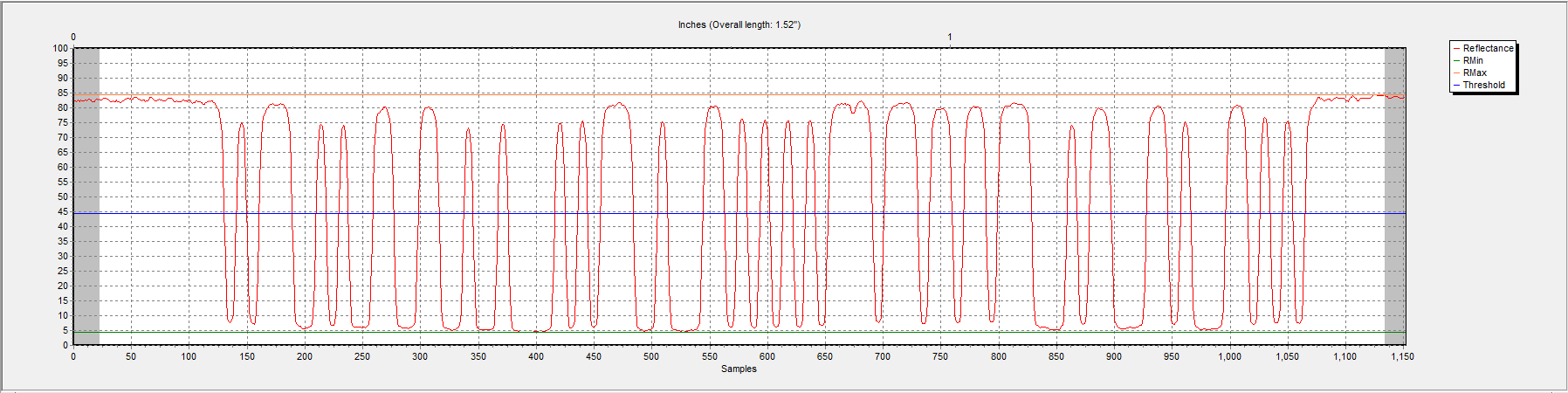
Here are the component parts, so you understand what you are seeing: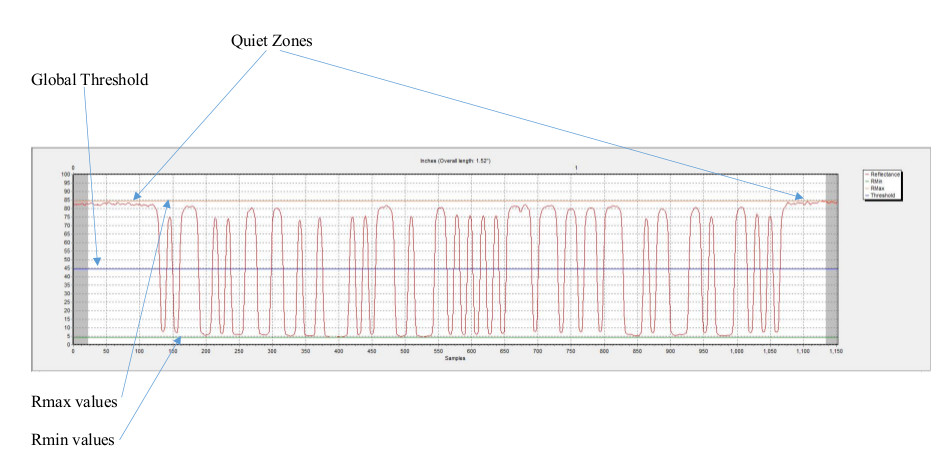
Here is what to notice about it: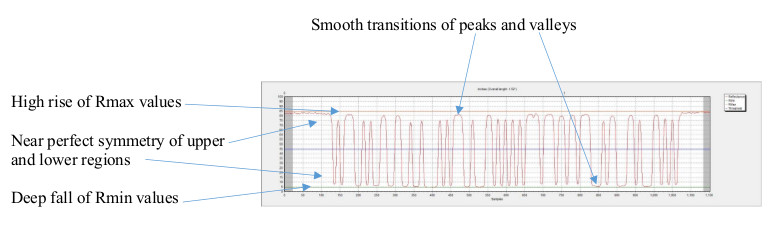
Not all 1D barcodes produce such a perfect SRP.
Here are some SRP’s from barcodes with specific problems:
Modulation
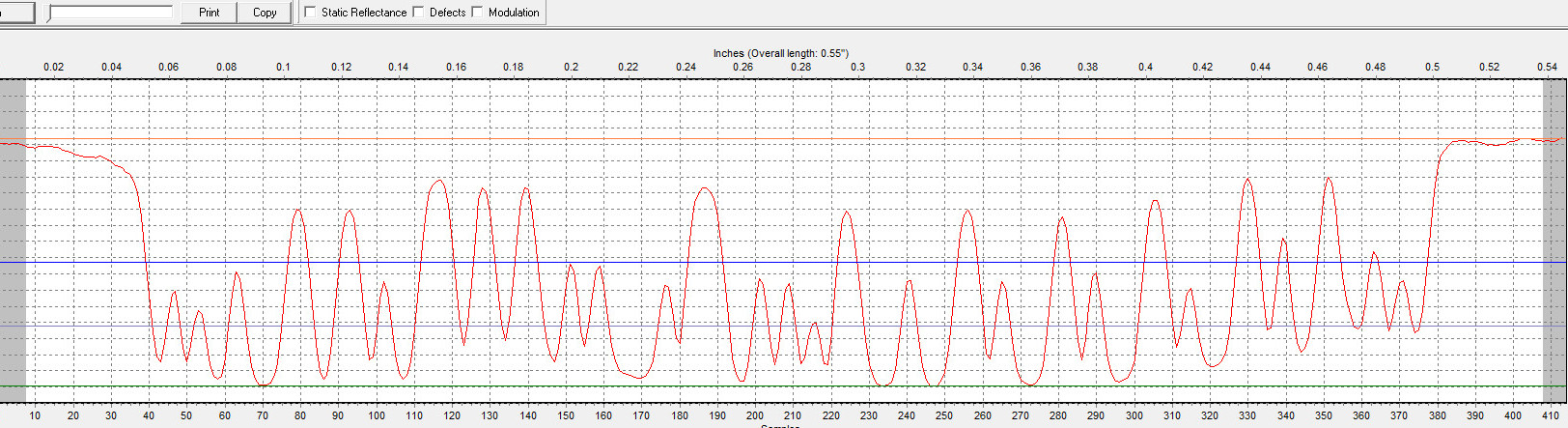
Notice the variation in the values particularly above the Global Threshold, but also in those below it. This symbol probably did not decode because many of the Rmax values did not intersect the Global Threshold. This means that the scanner did not detect them as bars and spaces.
Defects
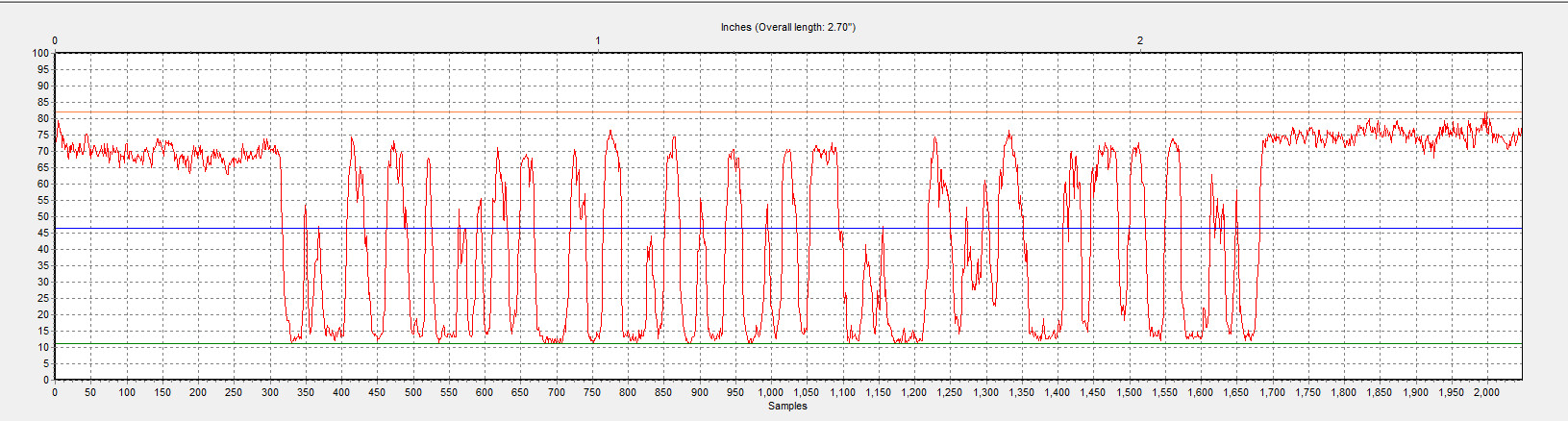
The SRP shows defects as jagged or non-smooth transitions at peaks or valleys. This SRP also shows artifacts, probably voids in the low reflectance (lower region) of the SRP.
Notice the jagged reflectance in the quiet zones. This must be a heavily patterned or fibrous substrate, reflecting non-uniform light values back to the scanner-sensor.
Low Contrast
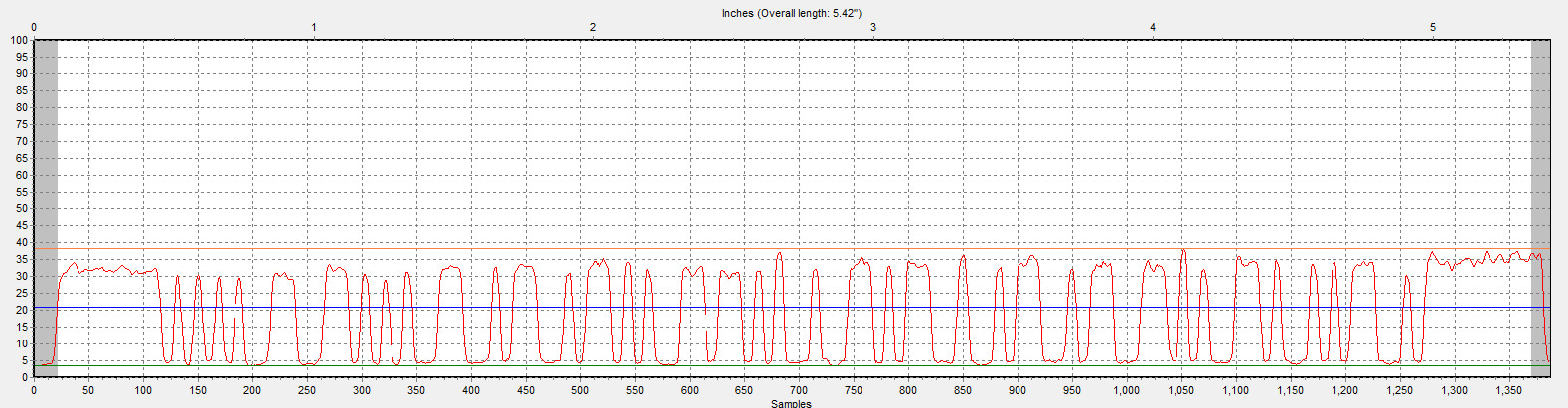
The highest Rmax values are very low. The reflective difference between the high and low values is very much compressed. This symbol of probably printed on a non-white surface, perhaps bare corrugated kraft.
The scan reflectance profile graphically displays the reflective performance of the barcode–reflectance differences are the basis for barcode scanning. To be more specific, scanning relies on the presence of two, different reflectance values, and a predictable number of transitions from light to dark. In this way, a scanner can distinguish a barcode in the midst of text or images, determine what type of barcode it is, and decode the information encoded in the barcode.
When there are more than two reflectance values, the parameter Modulation reports and grades that parameter, indicating that the likelihood of probably scans is in jeopardy.
When there are too many transitions from light to dark, as in the case of defects in the form of spots in the quiet zones or spaces, or voids in the bars, the parameter Defects downgrades the barcode, signalling an increased likelihood of scanning failure.
A uniform but decreased amount of reflective difference make sit more difficult for the scanner to distinguish the two reflectance values, again putting a successful scan in doubt.
Your comments are always welcome. Contact us here.