Your ISO compliant barcode verifier is telling you your barcodes aren’t perfect—great. But how do you use the information in the report to improve your barcodes? In this article we’ll discuss the verification reports for 1D barcodes. We will discuss 2D symbols in a later article.
Quick review. The ISO grade for a barcode is the lowest grade for any one parameter. If everything is an A but Modulation is a D, the final symbol grade will be a D.
We are mixing metaphors a bit here since the ISO system reports grades numerically. We will discuss the equivalent alphanumeric ANSI grade for sake of simplicity.
Symbol Contrast
Symbol contrast is a simple subtraction of the Dark reflectance value or RMin from the Light Reflectance value or RMax. The RMin value must always be the bars and the RMax must always be the background or substrate. If Symbol Contrast is not grading at least a C, chances are the RMax is too low or the combination of the two values are colors that are marginal. RMax should be 80% or higher and RMin should be in single digits.

Minimum Edge Contrast
This parameter measures the contrast difference between adjacent bars (RMin) and spaces (RMax) across the barcode. Any area where this contrast difference is non-uniform will cause this parameter to be downgraded. A substrate which has areas of dirt or solvent that cause the RMin pigment to be lower in contrast will trigger this parameter.
Modulation
Non-uniformity of substrate reflectivity across the barcode of the will result in varying RMax values, which are measured and graded in the Modulation parameter. A gradient background will do this. Likewise, non-uniform bars caused by variations in ink depositing will trigger Modulation problems.
This can be most graphically observed in the Scan Reflectance Profile and is most often seen above the Global Threshold line–when the spaces transition through it, as they do not in this example.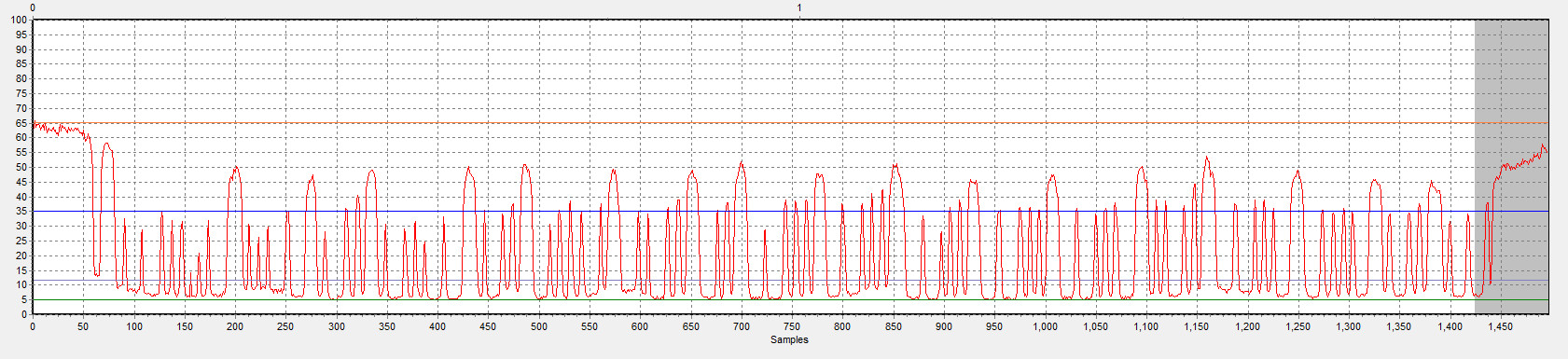
Defects
Voids in bars or spots in spaces can confuse the scanner, thinking that a void is actually a space between two bars or a spot is a bar. A substrate that is dirty can cause ink adherence problems, leading to Defects.
Inspect a barcode with Defects problems with a low power magnifier to actually see what is causing the problem—and how to resolve it.
Decodability
Low scores in Decodability are always the result of poor dimensional accuracy within the barcode. This could be caused by excessive bar gain, which is not an ISO parameter but which a high quality verifier will test and report. It is often a problem when other parameters such as Modulation are downgraded—check to see.
If Decodability alone is downgraded, the dimensional inaccuracies may be the result of inadequate printer resolution or a mis-match between the resolution of the printer and the design file that is driving it. Here again, a high quality verifier will report the dimensional properties of the barcode to isolate exactly where the problem is occurring.
Decode
A barcode will fail the Decode parameter if a quiet zone has been violated, a check digit is incorrect or if there is a basic structural error such as an incorrect start/stop pattern. In thermal printing this can sometimes be caused by a burned out print head pixel.