Meet Masahiro Hara, born in Tokyo in 1957. Mr. Hara studied electronic engineering at Hosei University and graduated in 1980, finding work at the Toyota Group.
Having seen the benefits of barcodes from their introduction in the United States, Toyota was keen to adopt them in their manufacturing process. The benefit of
error-free data storage promised an efficient solution, but several barcodes were needed to provide sufficient data capacity.
Linear Barcodes: a Solution–and a Problem
Scanning would take up to 10 seconds, slowing the manufacturing process. Barcodes were a solution—and a problem.
Barcodes also had other limitations. Barcodes only encoded alphanumeric data. In Japan, it was necessary to also encode Kanji and Kana characters.
Toyota’s parts component manufacturer, Denso Corporation, needed a solution. In 1992, Mr. Hara was given the challenge: make a barcode with greater data capacity but faster to scan. It was an honor to be given the challenge, and an opportunity to succeed—or fail. The development team was just two people: Masahiro Hara was in charge.
There were many challenges to confront. Providing large data capacity was one. A particularly vexing challenge was instructing the scanner where the encoded data began and ended, so the scanner could correctly decoded it regardless of its size or rotation.
From a Game to a Game-Changer
There is some controversy about what inspired Mr. Hara to develop the QR Code. One story is about lunchtime at Denso, a time to divert one’s attention to earnest play. The lunch tables had
gameboards of a popular game called GO, an ancient Chinese board game based on a grid and white or black stones. Mr. Hara recognized the possibility that the gameboard’s black-and-white pattern could be adapted to indicate the data sequence. Square finder patterns would occupy three of the four corners of the new symbol. This would enable the symbol to be correctly decoded regardless of its orientation.

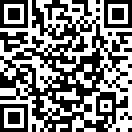
Two years later, in 1994, the QR Code was introduced. It could encode approximately 7000 characters including Kanji, and the data could be decoded up to ten times faster than other codes. Denso Corporation announced the release of their breakthrough in 1994. They decided to call it the QR Code. “QR” stands for “Quick Response”.
It was a proud moment for Mr. Hara and for Denso Corporation, but there was something more to be done. I hope I can state this with accuracy as well as deep respect for the Japanese culture. It was not enough that Denso Corporation had solved their own problem. They wanted to make the solution freely available worldwide. Although they owned the patent rights, Denso decided to allow QR codes to be used worldwide without a license.
QR Code received an AIM standard in 1997, for use in automatic identification, and in 2000 QR Code was approved by the ISO, receiving an international standard. This assured that it could be correctly structured for successful scanning anywhere in the world.
By 2002. QR Code was in widespread use in Japan. Soon mobile phones were capable of reading QR Code, accessing websites, electronic tickets, transport boarding passes and coupons.
QR Code–a Global Tool
QR Code continues to grow in use globally. The 2020 pandemic provided an opportunity for it to support non-contact transactions such access to restaurant menu’s.
Today, Mr. Hara is in his mid 60’s, living in Japan, surrounded by the many awards he has earned.
Here is an interesting video about his famous invention.
 Questions or comments? Contact us here.