I’ve repeated the ISO mantra about barcode verifiers repeatedly—and it is important. When you verify a barcode and it reports an A grade, there is nothing more you need to know, but when the grade is lowered by one or more of the ISO parameters, what then?
Here is a concise explanation of what each parameter means and how to improve the grade.
The ISO grading system for linear barcodes (parallel lines and spaces) is different from the system for 2D barcodes (QR Code and Data matrix), so we’ll explain them individually.
Linear Barcode ISO Parameters
Minimum Reflectance – This is the threshold of bar darkness compared to the light spaces and quiet zones. If this parameter fails, the bars and spaces do not have enough reflectance difference.
Minimum Edge Contrast – The transition from a bar to a space must be sharp and distinct, not fuzzy or gradient. Laminate is a common cause.
Decode (Pass/Fail) – Can a scanner accurately read the barcode with the reference decode algorithm? If not, there may be a basic structural problem such as a bar width error, a missing bar, or a violated quiet zone.
Symbol Contrast – Bars and spaces must achieve at least a minimum difference to be scannable. Scanners use red light. Bars must not be reddish, and the spaces and quiet zones must not be greenish. A red barcode on a white background, illuminated by red scanner light, appears entirely white. A black bar code on a green background, illuminated by red scanner light, looks all black.
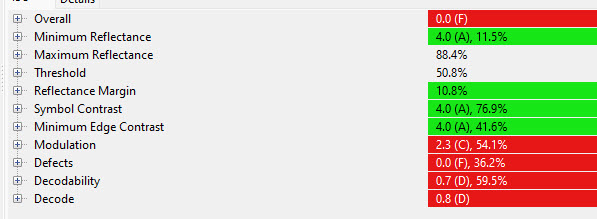
Modulation – The dark color of bars and the light color of spaces must be uniform. There should only be these two reflectance values. Additional dark or light reflectance confuses the scanner and is reported in the Modulation section. Problems are often related to excessive print gain.
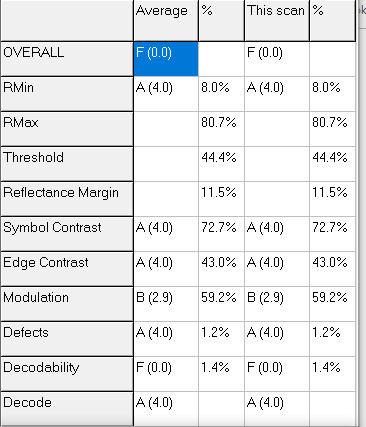
Here the problem is images in the background, causing variations in the light reflectance values.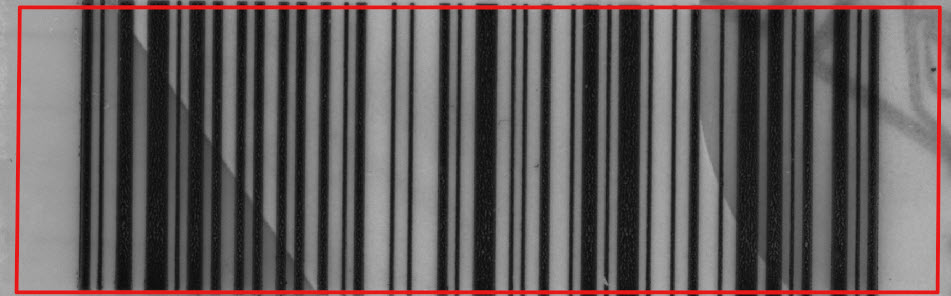
Decodability – Bars and spaces have specific widths and positions. Inaccuracies are reported in this parameter. A common cause is a difference in the graphics design file resolution and the printer resolution. 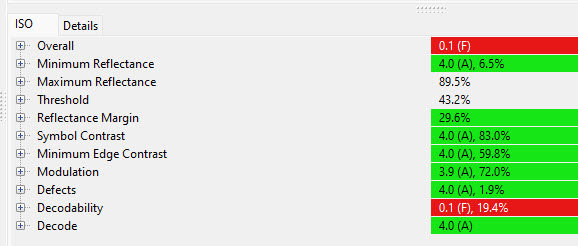
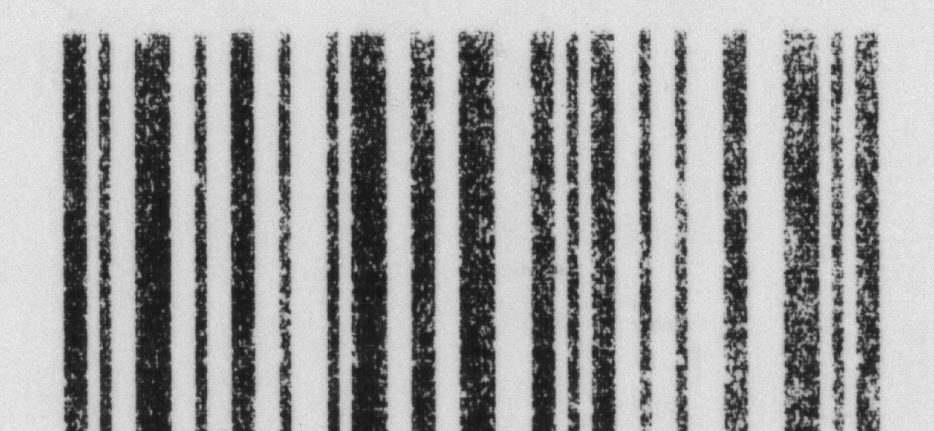
Defects – Voids in bars or artifacts in spaces confuse the scanner. Solvents, oil, dirt, and particulates on the substrate are common causes.

2D Barcode ISO Parameters
Decode (Pass/Fail) – Same as linear barcodes: can the decode algorithm decode the symbol?
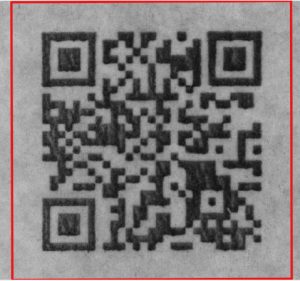
Symbol Contrast – Same as linear barcodes: higher contrast improves readability.
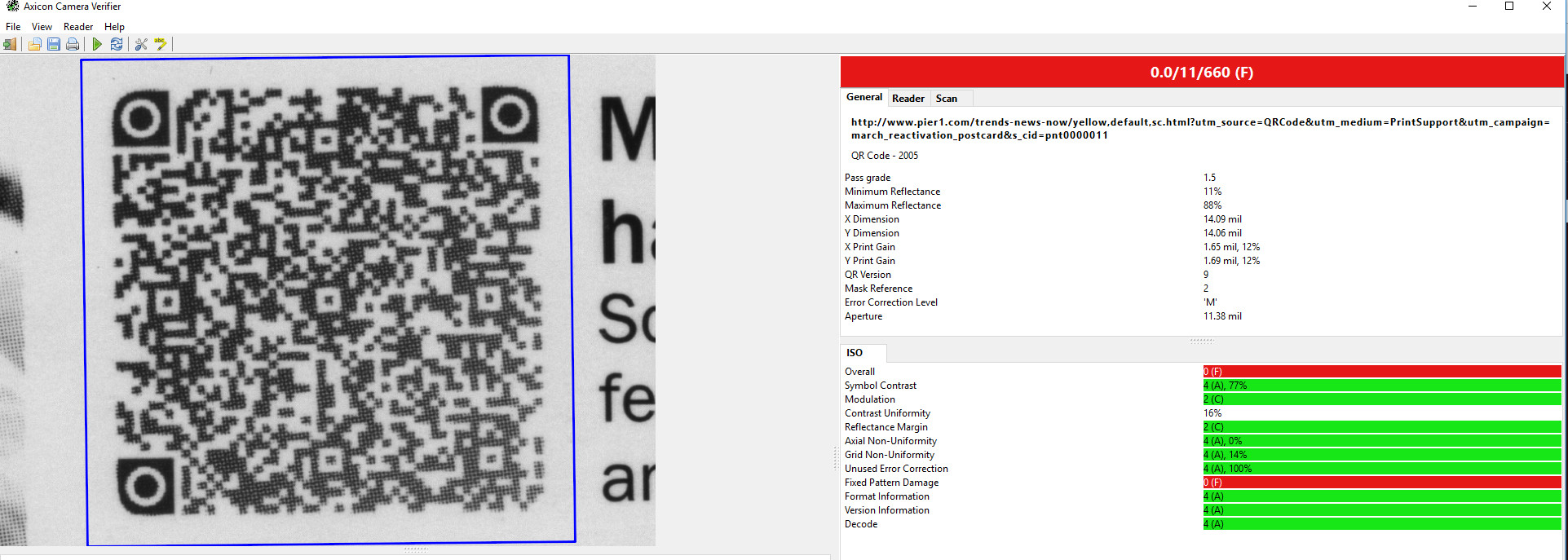
Modulation – Same as linear barcodes. Look for excessive print gain. In this example, the dark reflectance values are variable, possibly because of poor ink saturation or low print head temperature in thermal printing.
Contrast Uniformity – similar to Modulation, this grades how uniform Symbol Contrast is across the entire image. Inconsistent reflectance due to ink variations, glossy or textured. substrates or color variations are common culprits
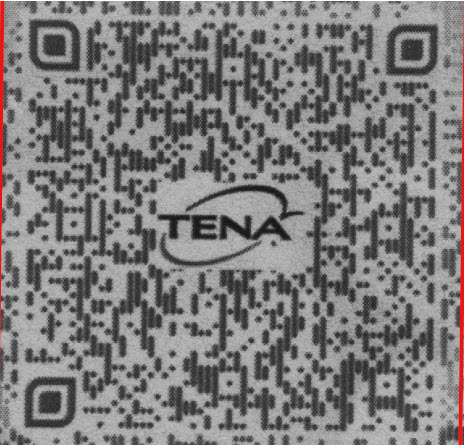
Fixed Pattern Damage – Non-variable patterns such as quiet zones, finder and timing patterns must be intact.
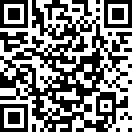
In this example, the problem is violated quiet zones.
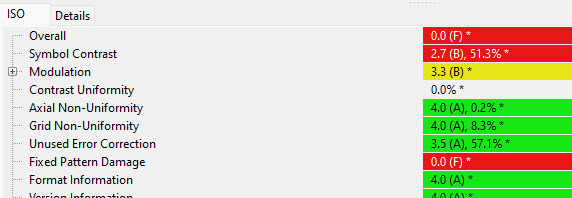
Unused Error Correction – Gauges how much error correction has been used. The closer to 100% the better.
Axial Non-uniformity – X and Y dimensions of the square modules must be within a tolerance.
In this example the QR Code is vertically rectangular rather than square.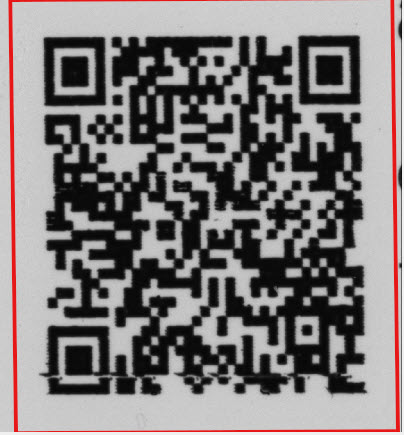
Grid Non-uniformity – Modules must fall on grid lines. Distortion is downgraded.
Print Growth – This new parameter was added in the ISO 15415 2024 update. It grades print gain due to insufficient bar width reduction or excessive image fattening.
I hope this overview of what the ISO verification report means and what to do to improve grading is helpful. Some problems are not this straightforward, but the main idea here is to introduce you to the logic in the standard.
 We’re here to help.