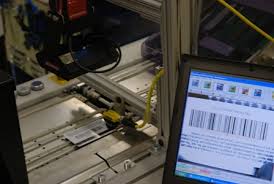
 Inline barcode verification is the hot fashion of the moment—if ever barcode verification was fashionable. Claimed advantages rest on the following points:
- Low cost compared to a person with a handheld verifier
- 100% verification compared to spot checking
- Highly accurate due to error tolerant scanning technology
Although not incorrect, neither are these claims altogether accurate. It is less expensive to have a machine do the work of a human, but this suggests that machines do not have a cost. And in any case, there is a trade-off.
Often a person doing barcode inspection is not a full time task. Many companies assign barcode verification to someone who has other responsibilities. With training and time, that person acquires a familiarity with what can go wrong with barcodes. When a problem arises, she knows what to do to rectify the situation and get the line up and running quickly.
An inline system creates an atmosphere of convenience. Nobody knows what to do when something goes wrong because nobody is really monitoring it. Inline systems claim to be superior because they do trending. Spot checking also does trending. Data can be stored in a spreadsheet format and each parameter and grade can be quickly and easily tracked over time.
The claimed low cost of an inline system is simply inaccurate. The system itself is expensive and the promised ongoing savings are quickly eaten up when something goes wrong.
As we have already seen, 100% verification does not uniquely provide trending data. But it does generate a lot of data. What to do with it? How long to store it?

Do you really want to dig through it when, weeks or months later, a customer reports a quality issue with it? Is all that data really a real, valuable asset?

Customers do expect a high level of accuracy with their barcodes. But they are less concerned with non-scanning barcodes than they are with barcodes that misread. If 25% of their barcodes do not scan, that’s a serious problem. But 1 or 2% is not. But misreading barcodes are potentially devastating.
This is where inline systems that promise high accuracy based on error tolerant scanners can be problematic. From an engineering standpoint, high accuracy and error tolerance are mutually exclusive: the latter does not create or even support the former. For

a scanner to be error tolerant means the scanner must interpolate positional or dimensional inaccuracies to decode the barcode correctly. That is where the problem becomes stealthy, even undetectable.
What happens when a scanner fails to read a barcode? Systems are programmed to halt; light stacks flash red, audible alarms sound, cell phones are called. All hell breaks loose.
What happens when a scanner successfully reads a barcode? In a serialized run, a successfully scanned but otherwise wrong barcode might be detected. In a run of randomly encoded barcodes, it probably would not.
Is this what you think you got with an inline verification system? Probably not.