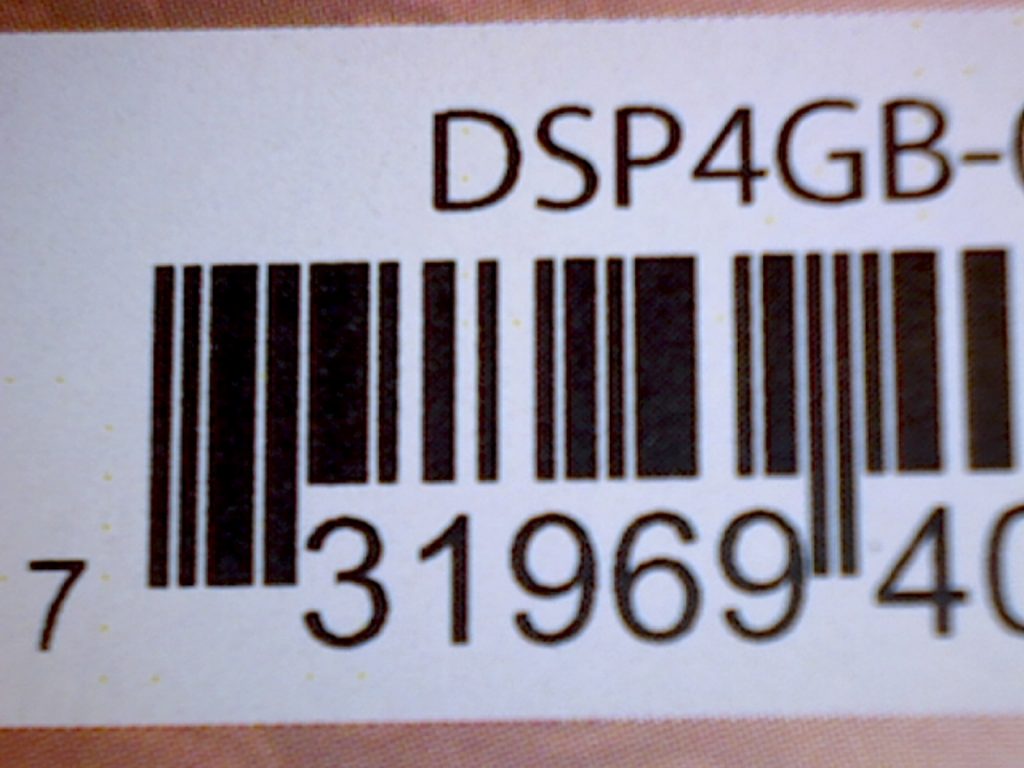
Just because these barcode mistakes are simple does not mean they are obvious—many of them are subtle—so subtle that some verifiers don’t detect them.
Barcode mistakes fall into two broad categories: design errors and printing errors. Neither is more important than the other. Perfect printing cannot overcome flawed design, but neither can perfect design overcome poor printing.
Truncation
Each barcode symbology has its own design specification which defines the width-to-height aspect ratio for the barcode. This is intended to make the barcode easy to scan and decode from any angle. Truncation or shortening barcode below the specified height makes it less likely it will scan at any angle. Barcodes on a conveyor line may be missed. Barcodes in a retail checkout will require rescans.
Below Minimum Magnification (UPC/EAN)

When these symbols are designed below the 80% minimum size, it reduces bar and space width tolerances, making the printer’s job more difficult and the symbols more likely to fail to scan.
Data Structure Mistakes
Incorrectly structured barcode data spells disaster. One of the simplest structural mistakes is a wrong (or absent) check digit. Some (but not all) design software preclude this. A more complicated and easy to commit mistake is to arrange the data sequence incorrectly, to encode an Application Identifier or the application data such as “Expiration Date” incorrectly. Again, some but not all design software prevent these errors.
Incorrect Wide/Narrow Ratio (ITF, Code 39)
Scanners identify different types of barcodes based on bar and space widths and patterns. When the design relationship between wide and narrow elements is violated, a scanner may be unable to recognize the symbology, or  may mistake it for the wrong symbology.
Incorrect Bar Width Reduction
Press gain or dot gain or ink spread—whatever you call it, reducing the bar width is an important way to make sure the printed bar code will scan successfully. Inaccurate bar width reduction (BWR) is probably the most common reason for barcodes failure. It is easy to determine the right BWR—just measure the printed bar and compare it to the width of the bar in the design file. The amount of gain is the amount of BWR that should be used in the design file. Beware, font-based design files do not permit BWR—don’t use font files to produce barcodes.

Violated Quiet Zones
Design errors often cause this problem, made worse by excessive print or dot gain. Different symbologies have different quiet zone specifications, and designers can mistakenly assume that there is a standard quiet zone for all barcode types and sizes. There is only a minimum quiet zone requirement—no limit at the maximum size. Why not make quiet zones generous and avoid any problems?
Wrong Location on the Package
GS1 Standards specify the proper location of the bar code on most types of packages. Barcodes on consumer products should be on the natural bottom of the box or bag. ITF-14 barcodes should be on the side of shipping containers so that scanner on conveyor systems can read them.
Wrong Barcode for the Package
Verifiers will tell you what the encoded information is, but most verifiers won’t signal a wrong barcode for the package. The only thing more disastrous than a barcode that doesn’t scan is a wrong barcode that scans perfectly. If product A is marked with the barcode for product B, the retailer will have inaccurate information about what they sold and how their inventory should be replenished. It’s a nightmare.