DPM or Direct Part Mark barcodes have been around for a long time, but this method for marking parts and sub-assemblies is evolving, as the use cases expand and advance. The military has long been a leader in using DPM to identify anything from engine blocks and major engine system such as exhaust, valve trains and intake manifolds. Aerospace was also an early adopter, marking jet engine components such as fan blades. More recently, medical device manufacturers have started marking implants and surgical instruments. As with conventional barcodes, marking parts provides a quick, simple and error –free identification method. Marking a part directly, on the part itself rather than on a tag or label, ensures that the identifying information cannot be lost or misapplied to a different part.
Linear DPM Barcodes
As the uses of DPM have evolved, so have marking methods. Early marking a was limited to photo-chemical etching, dot peen and engraving. Laser technology has made it possible to direct mark previously difficult to mark substrates including plastics and a wide variety of metals. And as in earlier use cases involving conventional barcode marking, standardizing DPM quality lags behind actual uses. In other words, some industries and applications are “pushing the envelope” into unknown and unregulated territory. An example from the automotive industry is the use of 1D or linear barcodes directly marked onto parts and subassemblies. The current DPM specification applies only to 2D symbologies and most (if not all) currently available verifiers cannot test and grade 1D DPM barcodes.

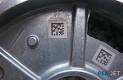 Verification of DPM symbols is a very important aspect of using them due to the vital roles they perform:
- Logging the maintenance history, failure rates and replacement scheduling of mission-critical machine parts in aircraft, military hardware and life-support equipment
- Tracking pharmaceuticals in the supply chain to assure security prevent counterfeit infiltration
- Recording implants in support of EMR (electronic medical records) accuracy and recalls
…and a broad spectrum of other applications.
 Because of its wide range of uses, DPM presents unique challenges to verification. Verification depends on standards, which provide the basis for predicting ability to successfully scan and decode the barcode symbol. Unlike a barcode printed in black ink on a white label where the reflective differences are specified and grade, a DPM symbol has an unpredictable (and usually very low) amount of reflective difference between the symbol and the substrate. What is the minimum acceptable amount of reflective difference? How is the reflectance value of a roughcast or stainless steel or aluminum substrate measured?
DPM barcodes on a flat surface are the simplest use case. Parts to be marked can also be cylindrical, and sometimes very small. As with conventional barcoding, DPM scanning is line of sight. The entire symbol must be visible to the scanner even on a tiny laparoscopic device or orthopedic fastener.
The most basic requirement of successful DPM scanning and verification is to capture the image. Much of the current work in writing a DPM Standard focuses on how to illuminate the symbol to the image. Lighting is a key factor in DPM scanning. The barcode data must be captured so that it can be analyzed against a defined set of graded attributes. Only then can a verification grade be calculated and scan success predicted.