Today there are 3 different types of barcode scanners. The broad categories are:
- Laser
- CCD
- Camera
Technically, there is a 4th type—the wand or pen scanner but this is old technology and few are still used.
Despite the significant technological differences, all scanners work on the same principle: reflectivity, or to be more precise, reflective difference. A barcode is imaged in some way over a substrate. The barcode is generally the darker, less reflective value; the substrate is the lighter, more reflective value.
These are expressed as:
Rmin = the low reflectance value
Rmax = the high reflectance value
This is the fundamental basis of all barcodes and barcode scanning, including 1D or linear barcodes, 2D or matrix barcodes and multi-color barcodes such as Pharmacode and Ultracode.

 Scanning a barcode is done on the basis of detecting the reflective differences between the bars and spaces of a 1D barcode, or the dark and light dots in a 2D barcode.
Some people believe (erroneously) that barcode scanning is done by a linear measurement of wide and narrow bars and spaces.
In the early days of barcoding, verification was done by measuring the width of the 30 bars and 29 spaces in a UPC symbol and comparing those widths to the amount of allowable error—the tolerances for those measurements. That was before the international standard for barcode quality was developed—and part of the reason that method of verification failed is that it did not accurately mimic the way barcodes are scanned. The measurement-based verifier would pass the barcode but the scanner could not scan it.
Barcode Verification is Prediction
Prediction is what verification is all about. Besides the risk management and quality control aspects of barcode verification, the reason you verify a barcode is so that you can predict whether or not it will work—regardless of whether it is read by a laser scanner, a CCD scanner or a digit camera-based scanner–or even a pen/wand.
We have already stated that reflective difference is the basis of scanning. There must be at least a minimum difference between the reflective value of the barcode image and its background or substrate. It is equally important that each of those reflectivity values be constant. The Rmax value of the background has an acceptable range of variability. Gradient or patterned backgrounds will confuse the scanner. In the same way, varying Rmin values of the barcode image can confuse the scanner.
Shadowing, serrated edges, voids and defects can all cause a barcode to fail to scan.

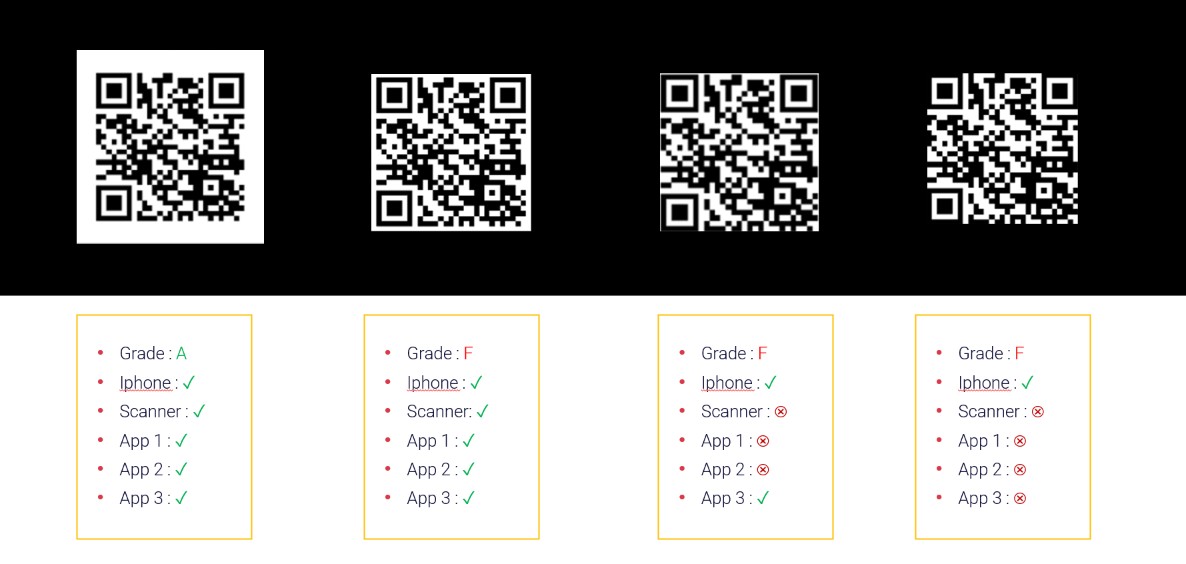
Finally, nearly all barcodes (1D or 2D) must adhere to a rule called Print Contrast Signal or PCS. This rule originated with the UPC and has been passed down to present day barcode practices.
The PCS rule states that the barcode must be the dark or Rmin value and the background or substrate must be the Rmax value. Negative image barcodes, for example white bars against an black background, are disallowed, even though they may pass the minimum reflective differences requirement.
The PCS rule does not prohibit reverse printing of a barcode. This can be a clever, cost-effective and successful solution in some circumstances, such as printing a barcode on a refractive surface such as an aluminum can..
Your questions and comments are always welcome. Contact us here.