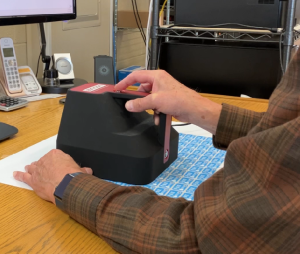
AI has entered the automatic identification space and barcode technology in particular. AI-enhanced scanners can decode damaged and partly obscured barcodes that conventional scanners cannot, and that ISO-compliant barcode verifiers would reject. Does this mean that barcode quality and verification are becoming obsolete?
 The Human Automation Bias
Such thinking is an example of the automation bias and complacency of humans. There are many things we human are uniquely good at. Maintaining a healthy skepticism about automation is not one of them. For example, when a barcode scanner emits a “beep”, we don’t question that the scanner correctly read the barcode—or that the barcode is the right one for that item.
Standards and Tolerances
AI-enhanced barcode scanners make mistakes. Successfully decoding a damaged barcode is done by bending the rules—the same rules expressed as standards against which verifiers measure and grade barcodes. A barcode verifier that complies with standards predicts whether and how well a barcode will scan on any scanner, anywhere in the world. Barcode quality standards include a set of parameters for identifiable attributes based mostly on calculations of visible-light reflectance values from the barcode. Some of the attributes are pass/fail. Others are graded. These express a tolerance, an allowable margin of acceptability from perfection or, if you prefer, a margin of error. The standard provides a defined threshold, a “line in the sand” that is accepted globally. All barcodes everywhere pass or fail based on the same standard.
Barcode and Verifier Standards
Verifiers are also held to a standard as a metrological instrument. All ISO-compliant verifiers, regardless of brand or model, must adhere to a globally accepted performance standard.
That “line in the sand” is blurred by AI. That barcode scanned correctly at a big box store in Florida, but what about other locations and scanners? There is no AI standard defines what’s acceptable or what’s not. The threshold is fundamentally unclear, and variable between brands. An ABC brand scanner may or may not read a barcode that scanned successfully with an XYZ scanner.
Is it even possible to put a number to the accuracy of an AI scanner? We know the data is available—but how do we capture it? How do we capture it when there is little interest or incentive in doing so? Whether or not you like the idea of chargebacks for bad barcodes, they are a motivator that levels the playing field. To avoid the expense, embarrassment and reputational damage of bad barcodes, the wise course is to achieve a measurable, provable level of quality.
5% = 100%
 A scanner that’s right 95% of the time is a dangerous tool. That 5% could be an expensive problem and the larger part of the problem is that the 5% is hard to find before the damage is done. Is anybody looking?
AI in quality delivers plausible accuracy. Based on training and trending, it’s acceptable, but it’s not deterministic. It’s adaptive, probabilistic. Five percent sounds like a very small number, too small to cause a lot of concern. That 5% is 100% unmanaged risk. What is the magnitude of that risk?
AI is a great tool in quality. It’s not the only tool.
 Contact us here.