CAPA Part 2: Linear Barcodes
You have a barcode problem.
A press is stopped, a customer is unhappy, a supply chain is broken…it’s an expensive, stressful nightmare. You need a solution—now.
Barcodes are Visual
Barcodes are visual images. Each image has a set of properties with tolerances. Those properties and tolerances are defined by international standards, established and maintained by the ISO.
Corrective actions for a non-working barcode are based on the applicable ISO standard for the barcode involved. ISO 15415 covers linear barcodes—parallel lines and spaces. ISO 15415 covers matrix or 2D barcodes.
Determining why a barcode is not working, or working poorly, is done with a verifier. The ISO standards enumerate a set of attributes and tolerances, each of which affects whether and how well a scanner can read and decode the barcode. Testing the performance of a barcode with a scanner is meaningless. Even though scanners are manufactured to comply with related ISO standards, scanners of different types, conditions and ages perform differently. Testing a barcode with a smartphone is even less informative since it uses a non-compliant light source and decode algorithm. Only an ISO compliant verifier can predict scanning success.

The key to determining corrective action is the verification report, since each ISO attribute is graded separately. Here is a sample linear barcode ISO 15416 verification report.
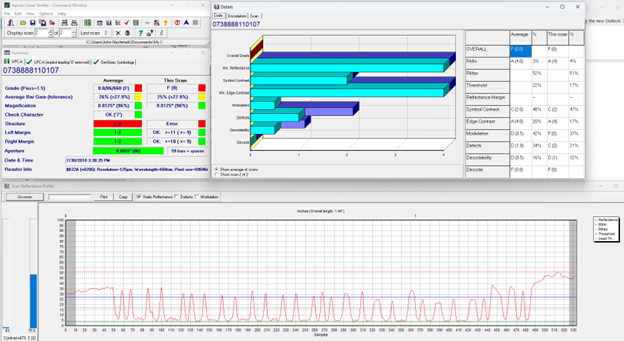
The red highlighted fields signal problems in this barcode. The upper left Summary window displays the final grade, an ISO 0.0 or ANSI F.
The Summary window also summarizes the state of this barcode. Average Bar Gain is 26%, and the tolerance is +27.9%. Printing used all and more of the plus-side bar width tolerance. That’s not good, and the right window tells you why.
The right window displays the individual attributes for this linear barcode, and the grade for each:
- Symbol Contrast is a C. This attribute measures and evaluates the amount of reflectance difference between the barcode and the background. That’s not great but it’s acceptable.
When Symbol Contrast is downgraded, it’s because either the dark (RMin) value (bars) are not dark enough, or the light (RMax) background, which includes the quiet zones and spaces, is not light enough. Correct one or both reflectance values.
- Edge Contrast is an A. That’s great. Edge Contrast grades the lowest (worst) difference in contrast between a dark element (bar) and the adjacent light element (space). Edge Contrast is a “worst case scenario” which is where a scanner is most likely to have a problem scanning it. If edge contrast is downgraded, find the problem area on the Scan Reflectance Profile and then look for it on the barcode image.
- Modulation is a D. Modulation grades the uniformity of the two reflectance values. Remember, a barcode should only have two reflectance values: light and dark. Each should be uniform. When they are not, it confuses the scanner and downgrades the verification report.
Look for patterns in the RMax areas or unevenness in the bars. Look for and correct (eliminate) patterns in the RMax areas or unevenness in the bars.
- Defects is a D. This attribute grades extraneous artifacts that can confuse the scanner; voids in bars, spots in spaces.Defects are caused by ink jet nozzle splatter, dirty or dusty substrate, particulate on impression rollers or other stray artifacts. Poor housekeeping is a common cause.
- Decodability is a D. Decodability grades the dimensional accuracy of the placement and width of the bars and spaces.
Scanner expect bars and spaces to be a specific width and positioned accurately to each other. Excessive gain spreads bars and squeezes spaces, putting the centers and edges in unpredictable places. Design file resolution (DPI) must be compatible with printer resolution. When it is not, the printer interpolates the data, relocating bars and spaces and modifying widths.
- Decode is a pass/fail attribute. Notice the Scan Reflectance Profile at the bottom of the report. The blue horizontal line is where the scanner decodes the barcode. Each transition through this line represents a bar and space. The scanner identifies the symbol type—in this case a UPC-A barcode—by counting the transitions and the width of the bars and spaces.
When a bar-to-space transition fails to cross the blue scan line, the count is thrown off and the scanner cannot decode the barcode. Excessive gain is a common cause of a decode failure.
Corrective Actions
Suggested corrections for each ISO attribute are italicized above.
Gain is not the only issue that can cause barcode problems, but it is the most common cause, and should always be the first thing to look for.
 Your questions and comments are always welcome. Contact us here. You can schedule a free 15 minute consultation here.