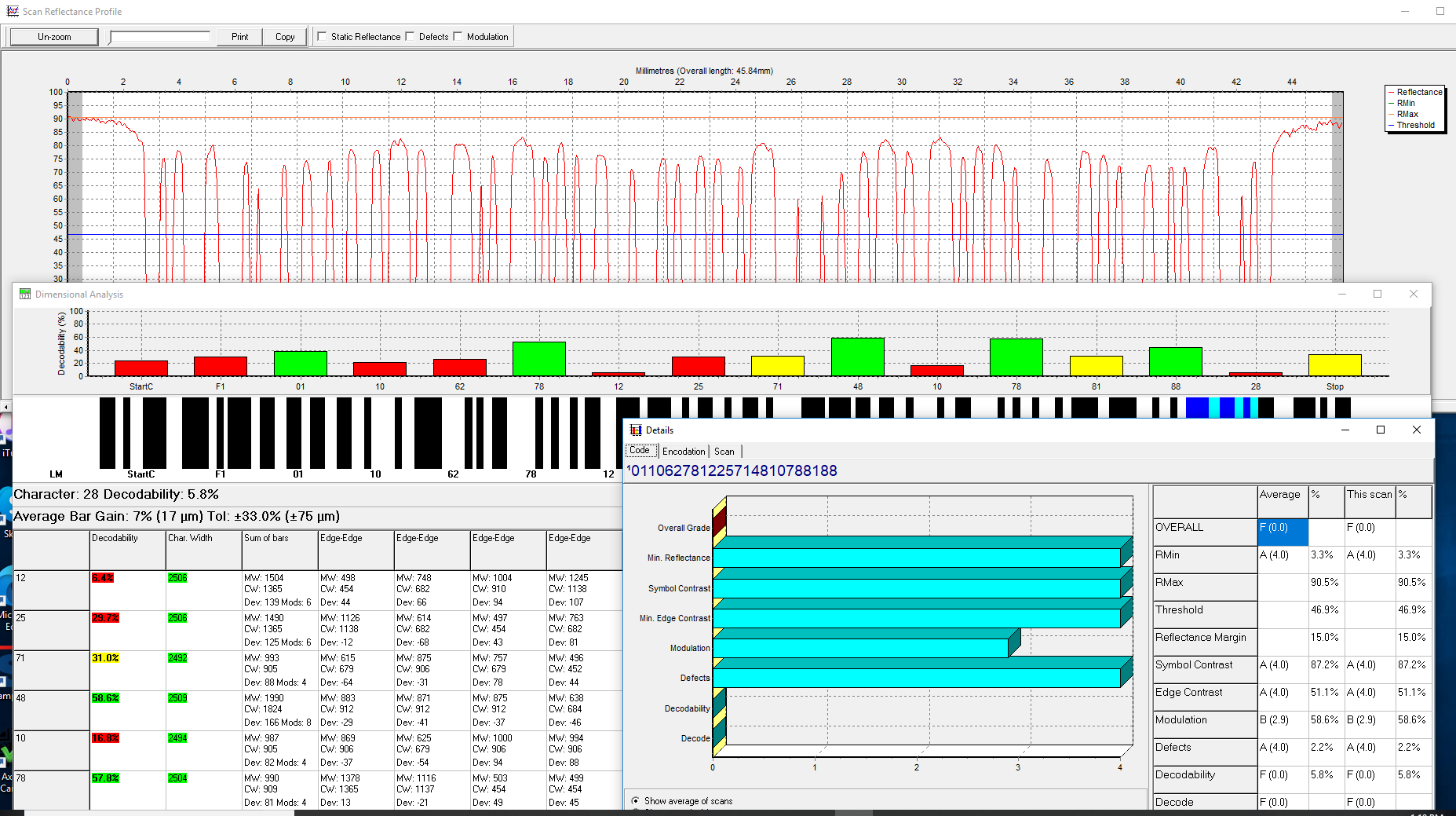
Decodability is an ISO 15416 parameter for evaluating 1D barcodes. As the name implies, it indicates the likelihood that the barcode will scan and decode correctly. But what exactly does it test and how does it relate to the final verification grade? Adding to the confusion, a standard formula is not used to calculate decodability for all linear barcodes. The decodability formula for a UPC is different from that for a Code 128.
Definitions
Here are some definitions for decodability:
- “…the measure of the accuracy of the printed barcode against the appropriate reference decode algorithm.” The Layman’s Guide to ANSI, CEN and ISO Bar Code Print Quality Documents, AIM, Inc. 2002
- “…a test in which the verifier examines each character in the barcode for correctness of the widths of bars and spaces.” GS1 Barcode Verification Process Implementation Guide, Release 24.1, Jul 2015
- “…a graded attribute that measures how near the scan reflectance profile is to approaching decode failure.” https://www.barcode.graphics/education-barcode-ansi-iso-parameters/
Interesting but not helpful. Most people want to know:
- What caused it
- What can I do about it

Cause and Effect
Print gain often causes Decodability problems. Gain, excessive spreading of the barcode image, makes it increasingly difficult for a scanner to see the narrow spaces in a barcode. Expanding bars narrow the spaces until they virtually disappear. When that happens, the scanner sees the correct number of bars and spaces, and decoding fails.
Un-sharp bar edges can cause similar problems. It is more difficult to distinguish a wide bar from a narrow bar when the edges are gradient. Is that a wide bar or two narrow bars with fuzzy edges? Lamination can cause un-sharp barcode edges.
The Root Cause
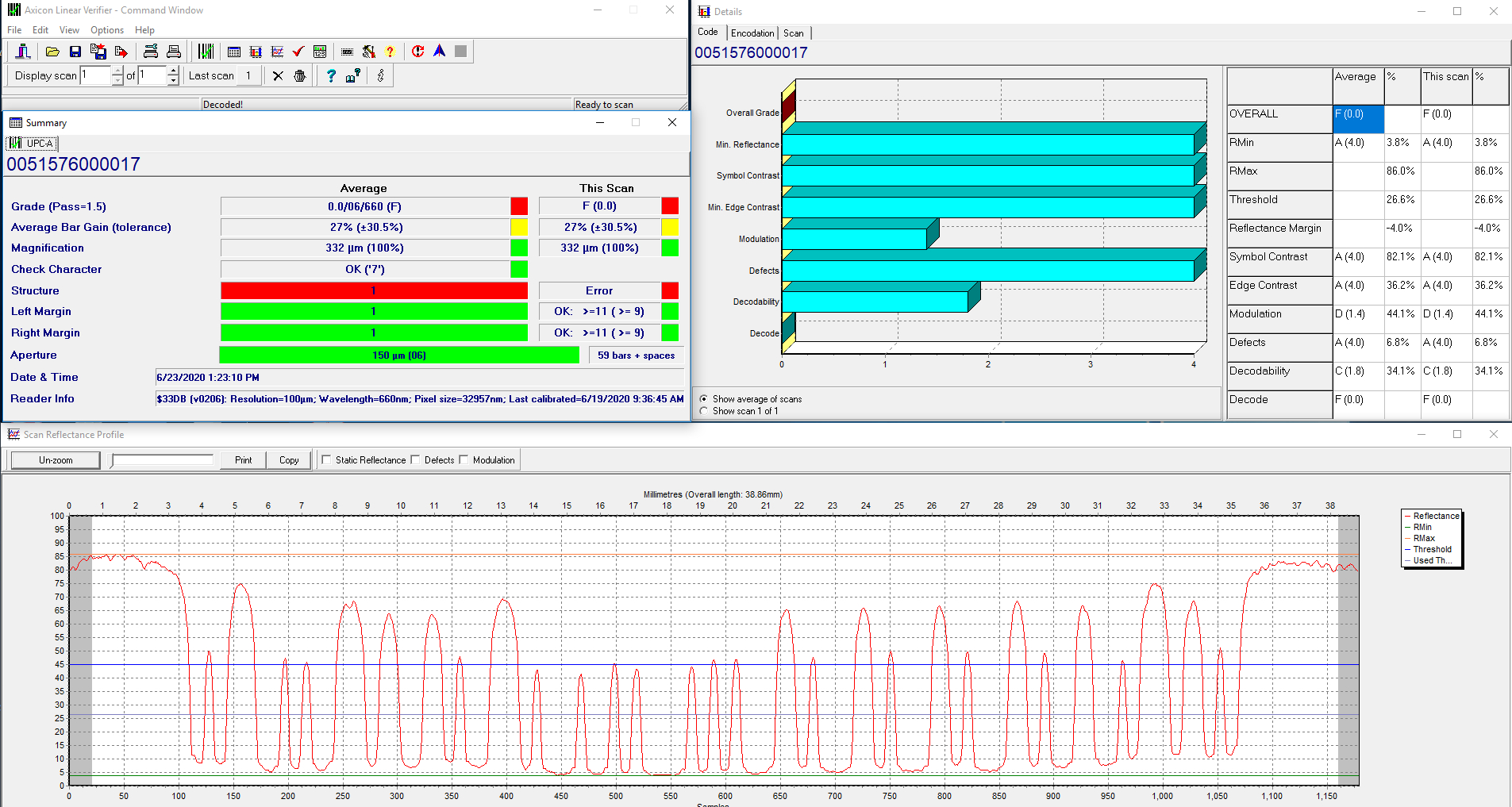
Scanners do not measure wide and narrow bars. They detect variations in reflectivity. Scanners decode barcodes by detecting variations in light and dark reflectivity. A scanner differentiates a UPC from a Code 128 barcode by detecting a predictable sequence of light and dark values in the correct sequence and combination of reflectance values. Read that again slowly—it is critical to understand decodability.
If the number of transitions from light to dark to light is incorrect, the scan will fail.
Wide bars reflect precisely less than narrow bars. Wide spaces reflect precisely more than narrow spaces. If the expected light and dark values are incorrect or out of tolerance, the scan will fail.
Gain is not the only cause for failure. Decodability degrades when bars and spaces do not fall in their expected locations. This can happen when a digital imaging device (thermal printer, ink jet system or digital press) gets a design command it cannot execute. When printer resolution and design file resolution are not the same, or are not mathematically compatible, the printer cannot place bars in their exact location. Images must be located where the pixels or spray nozzles are. There are no fractional pixels. Bar widths and positions relocate in whole pixel increments. Decodability suffers.
 Comments and questions are always welcome.
We test barcodes as a service. Contact us here.