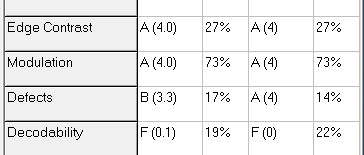
Decodability is one of the most difficult to understand of the barcode standards. The definition, “the ability of a barcode to be decoded” is simple but unclear for understanding its cause. Decoding is not measuring bar and space widths. Reflected light is the basis for decoding. However, bar or space width can cause scanning problems. Width accuracy is the basis for decodability grading.
Sometimes decodability problems are related to other ISO quality factors. sometimes not. Let us begin with a definition of terms:
Terms
—Element is a bar or space in a barcode. Elements have different sizes (widths) in 1D barcodes.
—Module is the smallest element in a barcode.
—Binary barcodes have elements of only two sizes: narrow and wide
—Resolution is the DPI (dots per inch) or pixel size of the printer.
Now, let us look at the causes of element width inaccuracies.
- Average Bar Gain
- Bars and spaces that are over-printed (or under-printed) can trigger low decodability grades. Frequently the verification report will also show Modulation problems, but not always.
- Pre-Press Resolution Incompatibility
- When the barcode design software does not set bars and spaces at an exact multiple of the pixel size, the printing device cannot accurately execute the file instructions. It will resize bars and spaces to the nearest whole pixel and re-position them in whole pixel locations. This is called “pixel rounding” and it causes accuracy conflicts with the decode software in the scanner.
- When printing at 200 DPI, one pixel is .005”. At 300 DPI, one pixel is .0033”. A low resolution printer will impose significantly more inaccuracy in the printed element widths.
- On-Press Problems

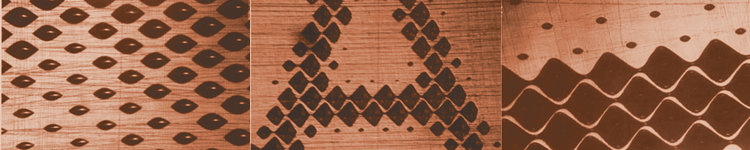
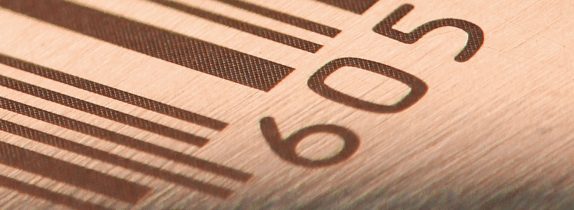
Image property of Ohio Gravure Technologies. No copyright infringement intended. - Fibrous substrates or those with non-uniform density can cause inconsistent gain across the length of a barcode. Recycled material is a culprit. Uneven, non-flat surfaces are also a common problem.
- Print methods such as rotogravure and screen print introduce jagged, uneven edges that trigger edge location inaccuracies.

Decodability problems more likely with some barcode types
Decodability is more likely to be a problem in non-binary barcodes. These are barcodes with more than two element widths. Non-binary barcodes types include:
- UPC and related symbols types such as EAN
- Databar
- Code 128
Unless the design software and printing device operate at a very high resolution (DPI), reproduction of some of the element widths will be inaccurate. This was a known fact, taken into consideration at time of invention. These symbol types rely on the tolerances, the allowable margin of error for element width, to decode. Therefore, even a well-printed Code 128 symbol printed at 200 DPI (for example) is somewhat accurate in some of the element dimensions. Other factors such as gain will further degrade element width accuracy.
No copyright infringement intended.
Scanners do not measure element widths to decide a barcode. Scanning works on reflective differences in elements of varying widths. It is helpful to understand measured element width differences to diagnose and improve low decodability grades.
Are you struggling to understand and solve a barcode problem? Let us help! Your comments and questions are always welcome. Contact us here.