The lab at Barcode Test LLC recently helped resolve a vexing supply chain problem. The vendor shipped parts marked with verified labels but the customer insisted they did not scan. Chargebacks were looming and stress levels were high. It was the perfect storm of factors on both sides of the equation.
X Dimension Blues
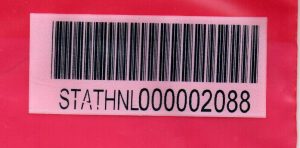 The customer’s linear barcodes were getting longer as their data requirements increased—but the label size was fixed. The vendor reduced the barcode to fit the label, and the customer’s standard resolution scanner could not decode the higher density bar widths. Both parties shared the blame; chargebacks were cancelled; the size-constrained 1D barcodes were replaced with 2D symbols.
Encroaching on quiet zones can also weak havoc with barcode scanability. In another recent situation, the vendor was providing pre-printed, verified labels, but the customer claimed they did not scan. Although the labels complied with a standard, agreed-upon format, the customer was affixing them to a range of packages, some quite small. Uninformed workers were applying the labels near the box corner, effectively cutting off the quiet zone. Once again, verification data saved the vendor.
Similarly, barcodes printed on uninstalled shrink sleeves may earn passing verification grades, but the installation process can distort and render them unreadable. The barcode should be printed in an area where shrinkage will be minimized. Printing barcodes in tapered surfaces such as bottlenecks should be avoided.
Perfectly Wrong Barcode
The verification report should always get a close examination, even when the ISO/ANSI grade is acceptable. In addition to print quality, other details about the barcode are displayed, for example symbol type, aka symbology. If the supply chain is expecting a Code 128 and you are providing a Code 39, the supply chain will reject it as a non-scanning barcode. Chargebacks will not be averted by the passing grade for the wrong symbology on a verification report.

The Red-Green Rule
 No, not Steve Smith, the Canadian carpenter/handyman.
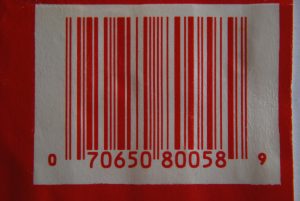
D grades for barcodes printed directly onto corrugated are widely accepted, but red barcodes on any substrate are unacceptable, and black barcodes on a green substrate are equally forbidden. The red-spectrum scanner light source will see red as equivalent to white. The barcode becomes virtually invisible.
 Scanners see green as equivalent to black.
Against a green background, a black barcode is indistinguishable.
Excessive truncation—reducing the height of 1D bars—should be avoided. Technically, it does not make a barcode unreadable, but it can make it less omni-directional. This is less of a problem with modern camera-based scanners, but directional laser scanners including counter-mounted multi-directional scanners may have difficulty obtaining a complete pass through a heavily truncated 1D barcode.
Comments are invited. Send your examples of non-scanning barcodes!