The ISO numerical grade relates to the ANSI alphabetical grade as shown on the following chart:
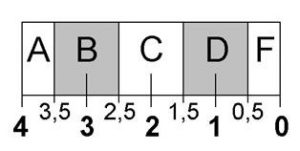 An A or ISO 4.0 Symbol Grade does not “guarantee” that a symbol will successfully scan everywhere. Nor does an F or ISO 0.0 Symbol Grade “guarantee” that a symbol will fail everywhere. Not all F’s are equally bad.
Symbol Grade is a guideline, a predictor but not a certification of scanning success. This is because scanning technology is an evolving opto-electronic technology, with varying electronics and varying firmware, all of them aging and operated with varying degrees of rough handling, all in different and varying environments.
The unit of measure for the verifier grade protocol is one scan. This is also known as first read rate. A symbol with an A grade will generally scan successfully on the first try.

An “A” Grade Does Not Guarantee Barcode Scanning
Symbols achieving a Symbol Grade B will not be as high quality as Symbol Grade A barcodes; one or more of the parameters is downgraded to a B; the first read rate will be lower. These symbols will likely require occasional rescanning to be decoded successfully.
Symbol Grade C barcodes will need to be rescanned more than B symbols. Rescanning means redundant scanning of the same symbol, and more frequent rescanning of different examples of the same symbol. It is important to understand that the performance of a single barcode does not necessarily predict the quality of an entire print run.
A symbol with a D may require multiple scans to decode successfully. F grade symbols are unlikely to scan successfully in most scanning environments.
An “F” Grade Does Not Guarantee Non-Scanning
Attributes that degrade symbol quality should be avoided—things such as gradient, variable or patterned background color or designer features such as logos or graphics within or near to the symbol. Users sometimes believe that F grade symbols are acceptable because the verifier was able to decode them. The significant thing is the Symbol Grade, not the successful decode. Verifiers and scanners differ in this regard.
How the Symbol Grade is obtained is an important consideration. The verification process should never be “optimized”. The test samples should be representative of the entire print run, usually drawn from the beginning and the end of the run, with in-process samples pulled periodically during the run.
Always Verify Barcodes in Their Final Form
Tested samples should always be in their final form exactly as they are ultimately presented to the end-user scanner. If they are laminated in final form, they should be laminated when they are verified. If they are inserted into a page of text, they should be in that form when verified.
The process is as important as the verifier device, which should be an ISO compliant device. It is meaningless to use a quality testing tool with no performance benchmark. For the same reason, the verifier should be recently calibrated and tested for conformance using performance qualification test barcodes with engineered errors of known type and magnitude.
It is good practice to have a reference standard card of barcode images available with which to confirm that a verifier is performing within its allowable range of tolerances as a test device. NIST-traceable calibrated, certified standard test cards are available for a range of 1D and2D symbols. They may be obtained from the following sources:
Barcode-Test LLC – http://www.barcode-test.com – 630-235-6077
Applied Image, Inc –https://www.appliedimage.com – 582-482-0300
GS1 – http://www.gs1us.org – (609) 620-4656