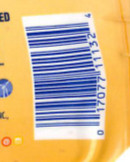
 The increasingly popular shrink sleeve presents an interesting, although not altogether unique challenge, to the issue of verifying the barcode. The challenge derives from the maxim that the best place to verify a barcode is in its final form: in the case of a consumer item, on the package with product inside—just the way the barcode will be scanned at point of sale. Final form could mean something different in other verticals such as medical devices, automotive parts or sub-assemblies, etc.
Flexographic labels are probably the closest thing to shrink sleeve barcodes, and the solution we suggest comes from this technology. Since, in most situations, there is no way for the shrink sleeve or flexo printer to test the barcode in its final form, we suggest creating a standard procedure for the way in which all the barcodes are tested. The standard practice in our barcode test lab is to position shrink sleeve and flexo barcodes over a white background that we save just for this purpose. To be clear, it is not a particular shade or reflectance value of white—it is the same white with the same reflectance value that we use over and over again.

Why is this important? It establishes a benchmark at a specific stage in the production process.
Prior to being installed on the container, prior to being heated to the shape of the container, prior to the container being filled with the product, one can authoritatively assure the customer that the barcode performs within its design specifications. This is the most any customer can ask, without the additional—and potentially disruptive step—of barcode verification as a final process, after shrink installation, heating and product filling.
Although those post-print operations could have a deleterious effect on barcode quality, and sometimes do, it is important to establish the barcode benchmark prior to those steps in order to better identify them as the root cause of the problem. Barcode verification only as a final process would not isolate these operations as the cause: it is possible that the barcode was bad before it was installed and heat-shrunk onto the container. Knowing that the barcode was good prior to installation, and isolating the problem to a post-printing process pinpoints the source of the problem and where to look for solutions.
At first, the solution we are suggesting might seem like a highly compromising solution. In fact it is just a more obvious compromise than the other compromises (or assumptions) we make in other barcode printing operations which, being less obvious, don’t even occur to us. Any print process contains a lot of moving parts, every one of them a potential variable. Plates wear, pigments can be uneven, heat builds up, roller surfaces and bearings age. Digital systems are not immune. Ink nozzles clog, transport speeds can vary, software can malfunction.
At the end of the day, certain assumptions must be made. If you are involved with shrink sleeves and have a protocol in place to monitor your barcode quality, we’d like to hear about it. Your comments are invited.