The Scan Reflectance Profile or SRP is a graphic representation of the changing reflectance values of a linear bar code across its width, from leading quiet zone to trailing quiet zone. As the scanner detects and, through a timing algorithm, “measures” the widths of each element (bar and space), it acquires a reflectance reading that is plotted like a sine wave on a chart.
The SRP forms the basis for the measuring and grading of nine characteristics (also known as parameters) within the ISO specification. Five of these are pass/fail; the remaining four are graded A-F depending on mathematical algorithms applied to the reflectance values detected by the verifier. It is important to note that the ISO grading system is based on the lowest parameter grade—the lowest grade is the symbol grade. There is no “averaging” of the final grade from the nine individual parameter grades.
The first consideration in symbol grading is where the reflectance values will be measured—in other words, where the actual decoding takes place. This occurs at a point half way between the highest detected reflectance or Rmax value and the lowest detected reflectance or Rmin value. This half-way point is plotted from left-to-right horizontally through the entire SRP, and is called the Global Threshold.

The Global Threshold or GT is where decoding of the symbol takes place. Decoding is a function of the scanner or verifier detecting a recognizable pattern of bars and spaces with a known combination of widths and the correct number of bars and spaces. All of those attributes must be present at the Global Threshold line and if they are not, certain ISO parameters will fail. This is usually visible on the Scan Reflectance Profile.
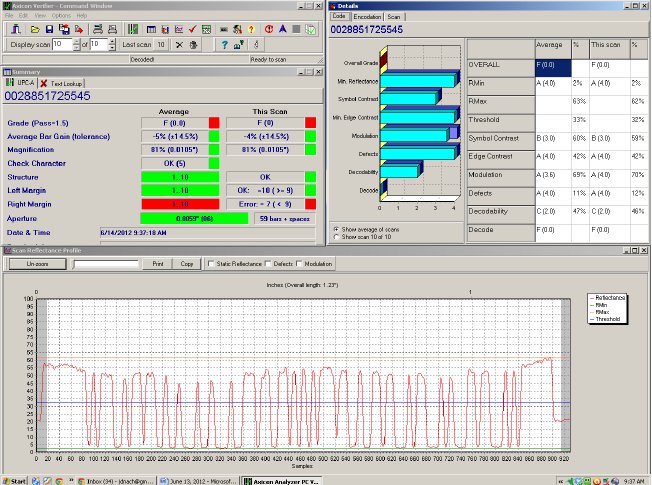
Note that on the example below, some of the elements (bars or spaces) plotted on the Scan Reflectance Profile do not penetrate the Global Threshold Line. Since this is where the count of bars and spaces takes place, the count will be off on this symbol, and the verification grade will be an F.
In this SRP, the elements have only two widths—wide and narrow. Thus narrow bars or spaces should be equal in width, and wide bars or spaces should also be equal. As you can see, they are not—narrow elements above the Global Threshold (spaces) are not as wide as narrow elements below the Global Threshold (bars). This causes the Scan Reflectance Profile to be asymmetrical between the upper and lower hemispheres. This is commonly caused by excessive print gain, which causes bars to fatten and spaces to shrink. Print gain can be so excessive it causes spaces to close up altogether, creating an element miscount.
Voids within bars or artifacts in spaces can also cause an element miscount, leading to a failure of the parameter Decode and Defects.
The unobstructed areas leading and trailing the bar code are the Quiet Zones. Each symbology has a specified minimum Quiet Zone, usually expressed as a multiple of the X dimension or narrow element width. When a quiet zone is smaller than the specified minimum, this parameter will fail. See SRP below.
It is important to understand how ISO grading works.
Each of the nine ISO parameters is calculated and graded based on the reflectance values that are measured by the verifier and graphically illustrated in the Scan Reflectance Profile.
While the SRP can be helpful in diagnosing certain conditions within a bar code, it is still up to the user to connect the dots from the SRP to the print process to determine what adjustments are necessary to improve the final symbol grade.