Different brands of verifiers format the verification report differently but the same basic information is presented. The most significant difference would be if the verifier you are using is not fully ISO compliant such as a verifier with a handheld gun-type scanner. These devices do not test reflectivity or contrast so the verification report will simply ignore these parameters. If you are looking for verifier, make sure the device tests the full set of ISO parameters for 1D barcode quality. It makes no sense to test anything less than the full specification.
The first thing to look at in the verification report is the Average Grade.  If it meets or exceeds the acceptable grade level, you need not go any further. If the Average Grade is at or lower than the target acceptable grade, find out what parameter or parameters are driving the Average Grade. Each of the ISO parameters is graded individually and because the Average Grade is determined by the lowest grade for any one parameter, find out which parameter is responsible and adjust your printing process accordingly. In our lab we call this the “driver parameter.”

It isn’t always obvious what is causing an ISO parameter to be downgraded. For example, Modulation may be downgraded due to reflectance variations in the substrate or background behind the barcode, or there may be some other reason. One good place to look for clues is the Average Bar Gain, which reports the amount of plus or minus deviation from ideal bar width. Usually it is reported as a percentage of X, and the total + tolerance is also reported as a percentage; for example, the Average Bar Gain may be 13% and the tolerance may be +33%. As a rule of thumb, Average Bar Gain should not exceed half of the total tolerance, in either the plus or minus direction.
Why would you want to pay attention to the “driver parameter” even if the barcode is grading at the acceptable level? Knowing what attribute is controlling the grade gives you a heads-up on what parameters is most likely to cause the barcode to deteriorate below that grade threshold. It helps you to think ahead and avoid a problem rather than react to one.
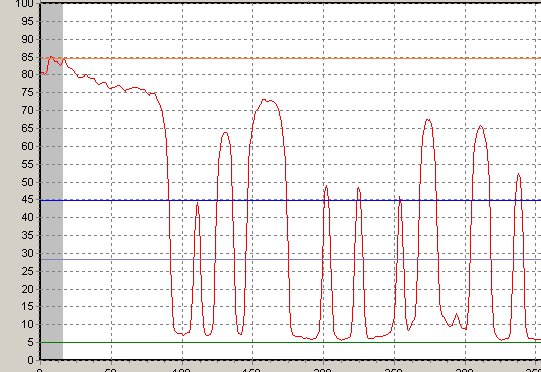 The Scan Reflectance Profile (SRP) is a very helpful tool in the verification report. It provides a graphic representation of the barcode as a sequence of light and dark reflectance values. The ideal SRP is symmetrical in the high and low reflectance areas of the profile. When this symmetry deteriorates, look for problems with excessive bar gain or poor Symbol Contrast.
When Decodability is the driver parameter, a dimensional analysis of the barcode can be a helpful tool in the verification report. This shows the entire barcode, bar by bar and space by space as a chart of ideal measurements as compared with actual measurements. If positional or width deviations show up in discrete areas of the barcode, this almost always signals a “pixel rounding” problem caused by printer resolution incompatibility with the design file.
Questions about a verification report or a barcode problem? We’re here to help.