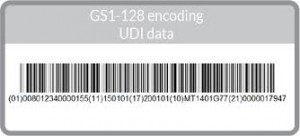
 As the FDA rule rolls out, there is a lot of confusion about the UDI barcode. What is required? Where must it be shown? How is it structured? For reasons we don’t completely understand, it is very difficult finding answers to these very basic questions.
The UDI or Unique Device Identification is, as the name implies, a string of alphanumeric data displayed in barcode form to uniquely identify a medical device. The manufacturer of the device is responsible for both assigning the data string and making sure it is present on the device and that is scans correctly.
A UDI barcode is usually comprised of two parts, a DI or device identifier and a PI, a production identifier. Think of the DI as a UPC which identifies a class of products such as a can of Coke(R). Every one of millions and millions of cans (or medical devices) bear the exact same number. In fact the UPC (AKA GTIN 12) is the very same thing as the DI in the UDI system.
If your medical device is marked and sold only with a UPC (GTIN12), that is all that is required and your device is already FDA compliant. However if your device is also marked with an expiration date, you are required to include the PI portion of your UDI barcode.

Think of the PI as the portion of the USI that makes it truly unique to your device. It can include up to 5 types of data:
- Expiration data
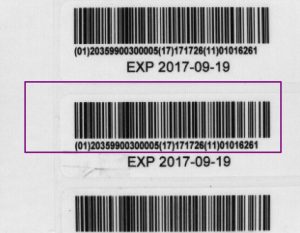
incorrect date format - Bath or lot number
- Serial number
- Manufacturing date
- Distinct identification code (identifies the donor of human cell tissue products)

Each of the PI components has a prefix number which appears in parentheses in the human readable interpretation adjacent to the barcode. This alerts the scanner that am expiration data or batch number will follow. And each component has a specified number of characters in its defined field of data. Also, dates must be presented in exactly the right sequence, starting with a four digit year, two digit month and two digit day.
The idea behind the PI is to identify anything critical to making a possible product recall as efficient and effective as possible, thereby minimizing the scope of a recall while maximizing its speed and accuracy. Thus a kit such as a drug testing kit or a first aid kit which contains many component parts will bear a UDI barcode and every component part will also bear a UDI barcode.
Devices that are implantable or on which a self-adhesive label would not survive such as an autoclaved surgical instrument must have the UDI barcode direct part parked. Often this is done with a laser marking device or a chemical etching process.
As always your comments are welcome, as well as your experiences or observations with the UDI system.